
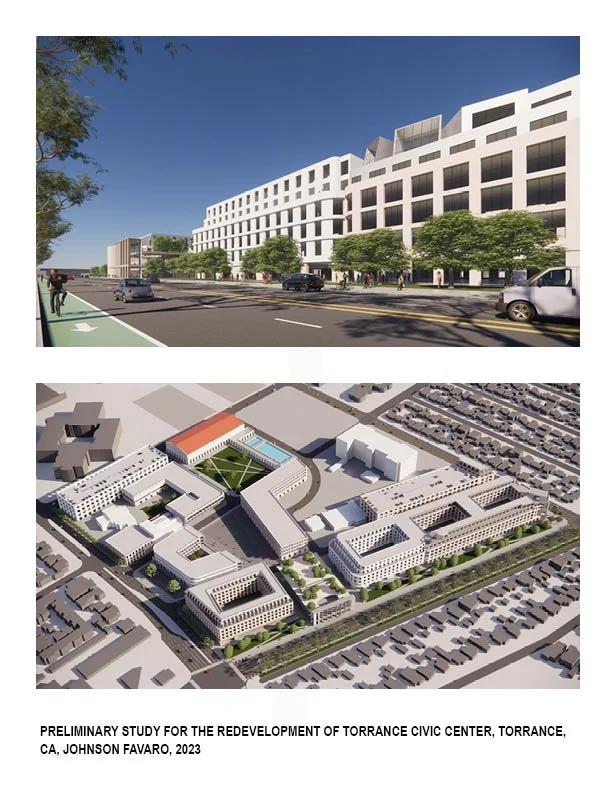
PUBLIC SECTOR INITIATIVE An example of what a municipal government could be capable of were it to take the initiative, this plan would accommodate a variety of uses including residences of the kind that people would want to live in. (Study for Redevelopment of Torrance Civic Center, Torrance, CA, Johnson Favaro 2023)
Ten years ago, the philosopher Nick Bostrom in his book “Superintelligence: Paths, Dangers, Strategies” shared a thought experiment known as “the paperclip maximizer” to illustrate his concerns about what had as early as the turn of the 21ST century come to be known as the AI “alignment problem”.
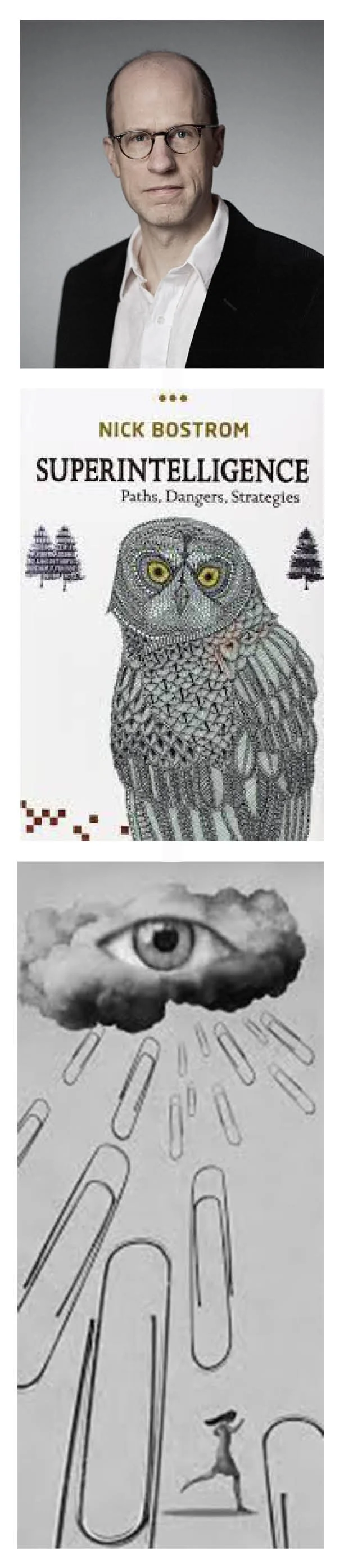
TOP Image: Nick Bostrom. Official portrait. Nick Bostrom.
MIDDLE Image: Bostrom, N. (2014). Superintelligence: Paths, Dangers, Strategies. Oxford University Press.
BOTTOM Image: Paperclip Maximizer illustration. Inspired by Nick Bostrom's thought experiment in Superintelligence (2014). Original artist unknown.
MISALIGNED VALUES As much as philosophers and AI developers fear the alignment problem with artificial intelligence, examples abound over the course of human history of how we humans--our economies and our building patterns--can mis-align with our core values.
Despite the hype to which we are daily subjected, no AI has a mind (or heart) nor therefore goals or values of its own except those for which it has been trained. Unless in its training the AI’s goals are expressed (by us) with accuracy, nuance and subtlety and in precise alignment with our values, ethics, standards of behavior and norms will it deliver without any regard for any of that. This is the alignment problem.
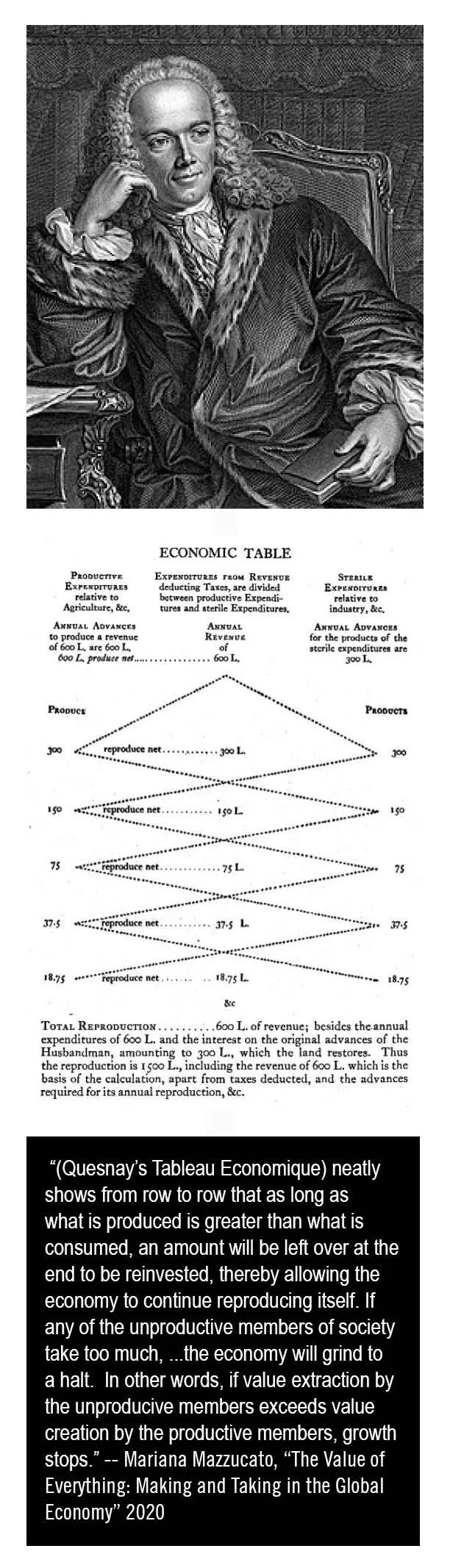
TOP Image: François Quesnay. Engraving portrait. Bibliothèque nationale de France.
MIDDLE Image: Quesnay, F. (1758). Tableau Économique.
BOTTOM Image: Mazzucato, M. (2018). The Value of Everything: Making and Taking in the Global Economy. PublicAffairs.
MAKING AND TAKING Political economics originated with the French 18th century philosopher/economist Francois Quesnay (1994-1774), whose work established the theoretical foundations for what became modern capitalism and which from the beginning distinguished between “productive” (making) and “extractive” (taking) economies.
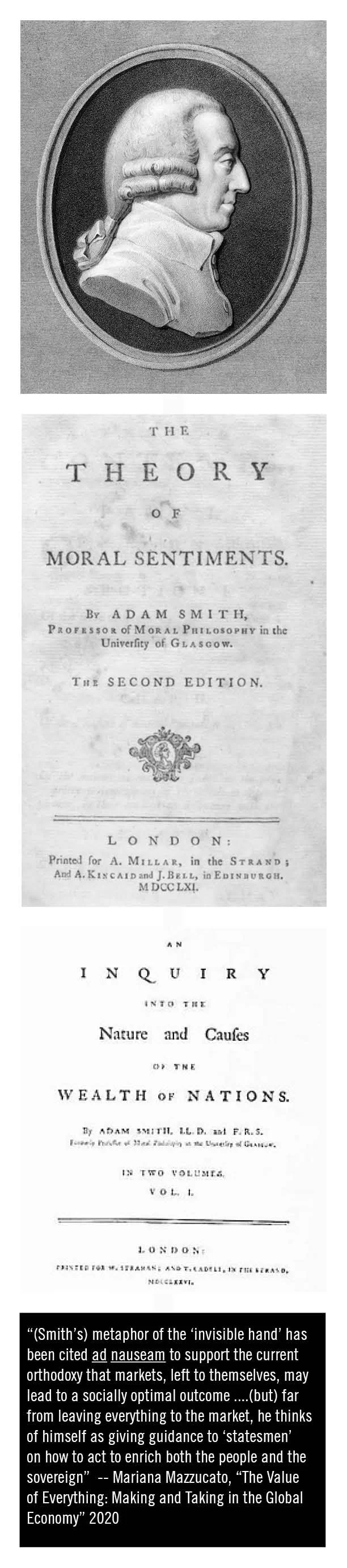
TOP Image: Adam Smith. Engraved portrait. Public domain.
MIDDLE 1 Image: Smith, A. (1761). The Theory of Moral Sentiments (2nd ed.). London: A. Millar.
MIDDLE 2 Image: Smith, A. (1776). An Inquiry into the Nature and Causes of the Wealth of Nations. London: W. Strahan & T. Cadell.
BOTTOM Image: Mazzucato, M. (2018). The Value of Everything: Making and Taking in the Global Economy. PublicAffairs.
INVISIBLE HAND METAPHOR The famous, variously interpreted, and misinterpreted Adam Smith quote from both Moral Sentiments and Wealth of Nations: “He intends only his own gain, and he is in this, as in many other cases, led by an invisible hand to promote an end which was no part of his intention….”
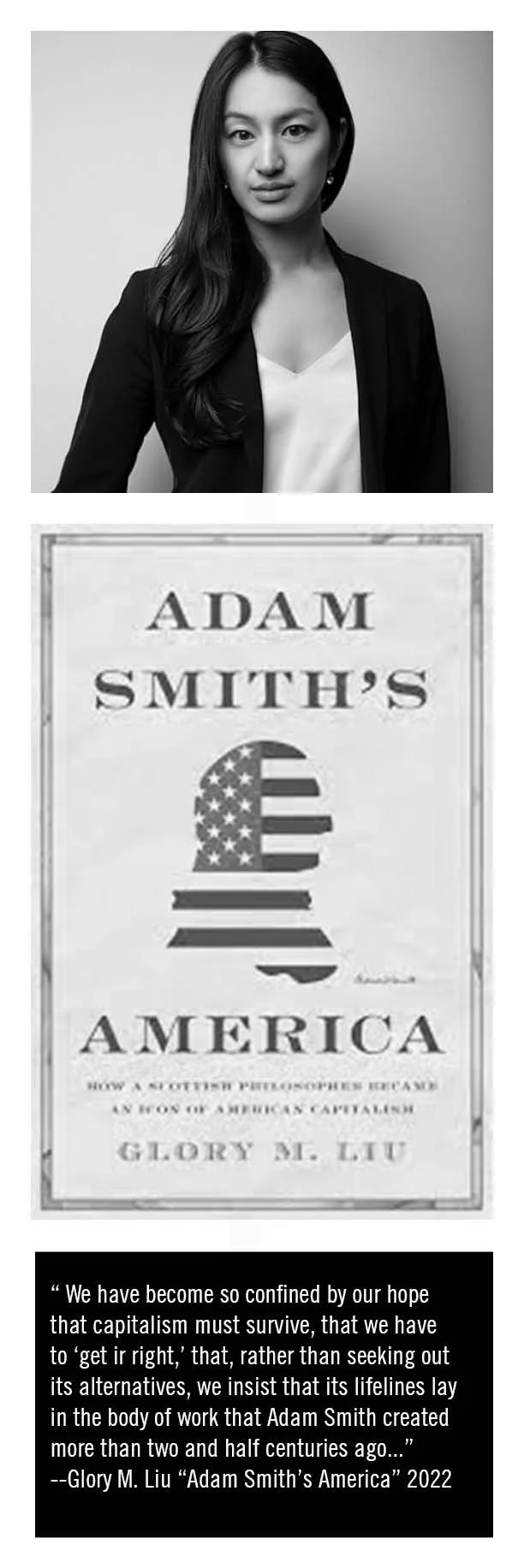
TOP Image: Liu, G. M. Official portrait. Harvard University. Retrieved from https://gov.harvard.edu
MIDDLE Image: Liu, G. M. (2022). Adam Smith's America: How a Scottish Philosopher Became an Icon of American Capitalism. Princeton University Press.
BOTTOM Image: Paraphrased from Glory M. Liu, Adam Smith’s America: How a Scottish Philosopher Became an Icon of American Capitalism (Princeton University Press, 2022).
FREE MARKET MYTH This historian has demonstrated that for over 250 years economists in America have deployed varying interpretations of the writings of Adam Smith to 1) convey authenticity and authority and 2) support the dogma of the moment including in our time our unqualified faith in the virtues of “the market.”
If, for example, you give an AI the capability and the goal of making as many paper clips as possible without expressing any caveats such as don’t strip mine the earth, monopolize the internet or our energy infrastructure, or hurt or kill people there is no guarantee that it won’t do all those things to maximize its fulfillment of the goal. But doing those things would, of course, be out of alignment with our values (and our survival).
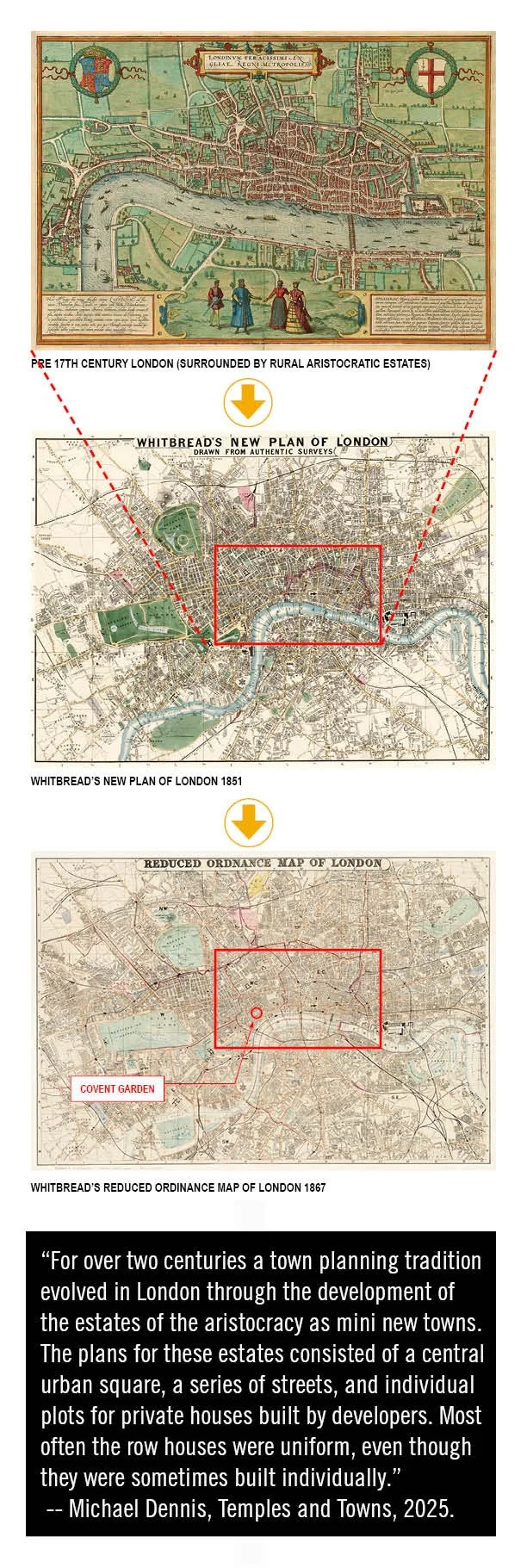
TOP Image: Braun, G., & Hogenberg, F. (1572–1617). Londinum Feracissimi Angliae Regni Metropolis. Public domain.
MIDDLE 1 Image: Whitbread, J. (1853). Whitbread's New Plan of London: Drawn from Authentic Surveys. Library of Congress.
MIDDLE 2 Image: Whitbread, J. (1868). Reduced Ordnance Map of London. The London Archives / London Picture Archive.
BOTTOM Image: Paraphrased from Michael Dennis, Temples and Towns: The Making of Urban Civilization (2025).
SPECULATIVE REAL ESTATE ORIGINS The aristocratic estates surrounding London were had all been mostly in a state of decline since at least the 18th century rendering their owners land rich and cash poor, hence the need to develop their land, developments which expanded the footprint of the city and have become some of the most sought after neighborhoods in the city.
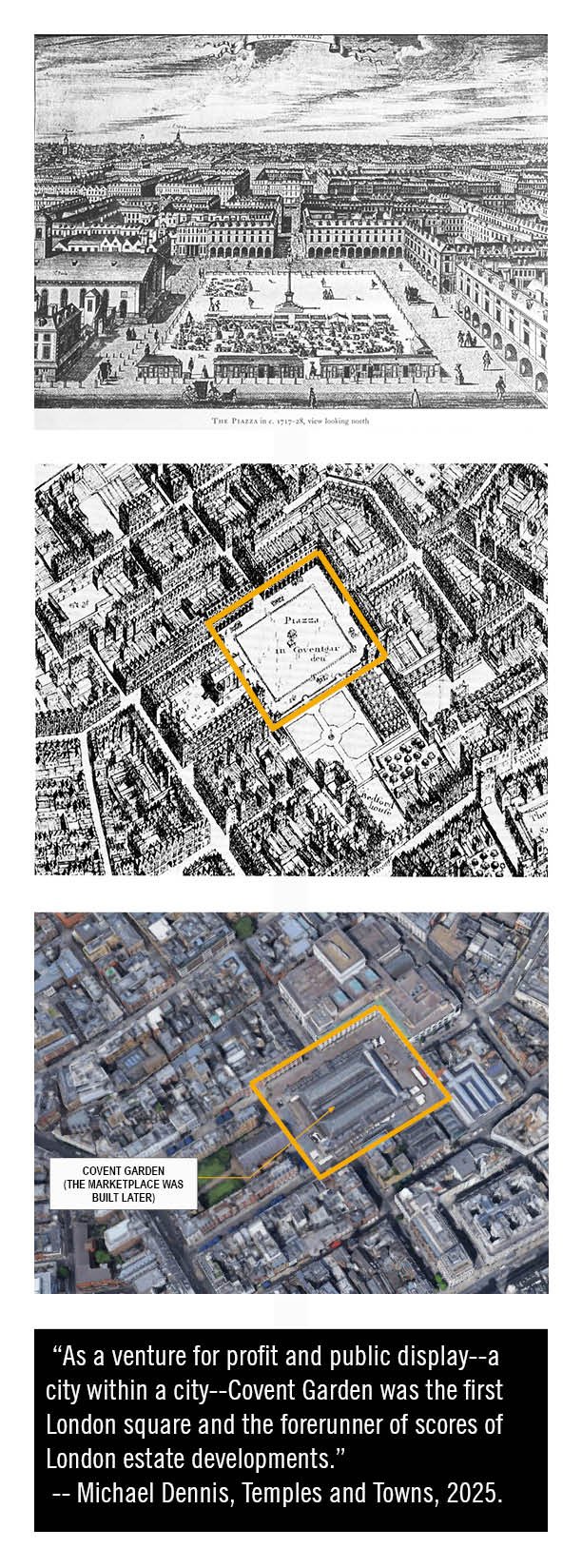
TOP Image: Kip, J. (c. 1717–1720). The Piazza in Covent Garden (view looking north). Public domain.
MIDDLE 1 Image: Rocque, J. (1746). A Plan of the Cities of London and Westminster, and Borough of Southwark. Public domain.
MIDDLE 21 Image: Google Earth. Satellite imagery of Covent Garden, London. © Google.
BOTTOM Image: Paraphrased from Michael Dennis, Temples and Towns: The Making of Urban Civilization (2025).
RESIDUAL VALUES Composed by architects the plans that emerged for these properties included squares, parks, affirmatively designed streets, row houses, and flats. Imbedded in them are values and norms of town planning that had matured over centuries of experience in the western world, mostly on the European continent. (Covent Garden, Inigo Jones, London, England, circa 1630).
Two and a half centuries ago the 18th century philosopher and political economist Adam Smith (Scotland, 1723- 1790) wrote two books: “The Theory of Moral Sentiments” (1759) and “An Inquiry into the Nature and Causes of the Wealth of Nations” (1776). To this day “Wealth of Nations” is frequently cited to buttress arguments about political economy in the United States.
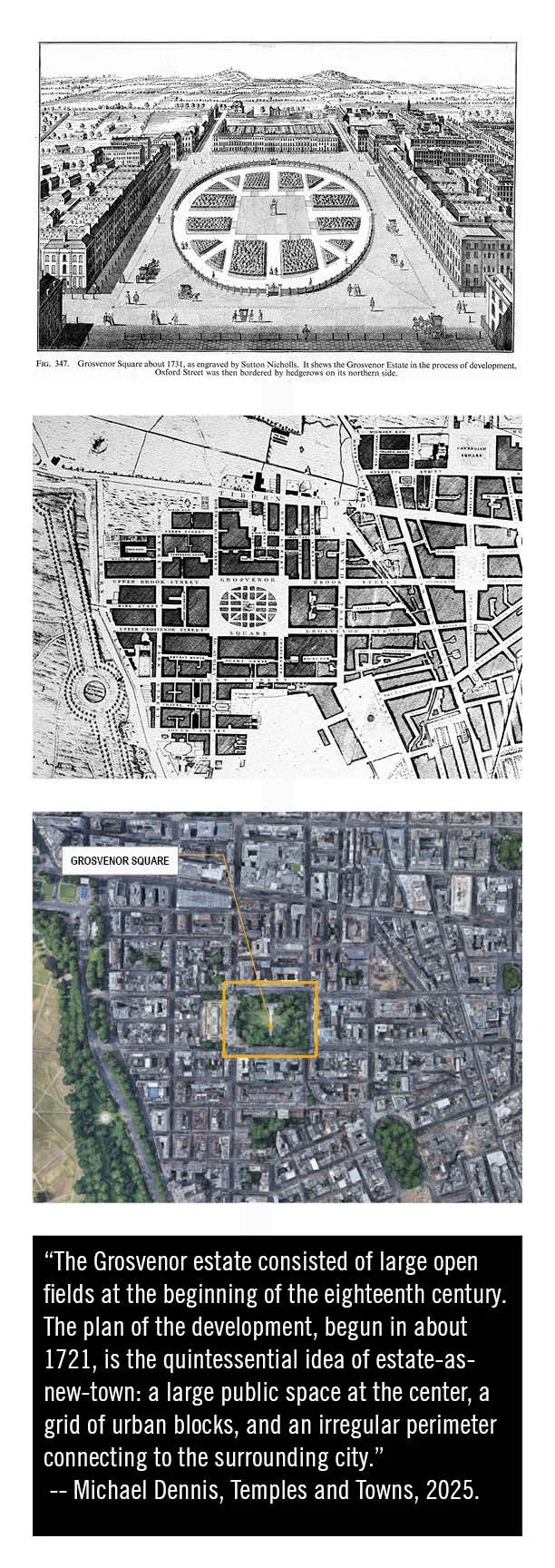
TOP Image: Nicholls, S. (c. 1731). Grosvenor Square, London. Engraving. Public domain.
MIDDLE Image: Rocque, J. (1746). A Plan of the Cities of London and Westminster, and Borough of Southwark. Public domain.
BOTTOM Image: Google Earth. Satellite imagery of Grosvenor Square, London. © Google.
BOTTOM Text: Paraphrased from Michael Dennis, Temples and Towns: The Making of Urban Civilization (2025).
CORE VALUES The neighborhoods produced by the estate developments always centered around a stable core, the square, around the perimeter of which residences aligned and out of which emerged streets that connected to the rest of the city.
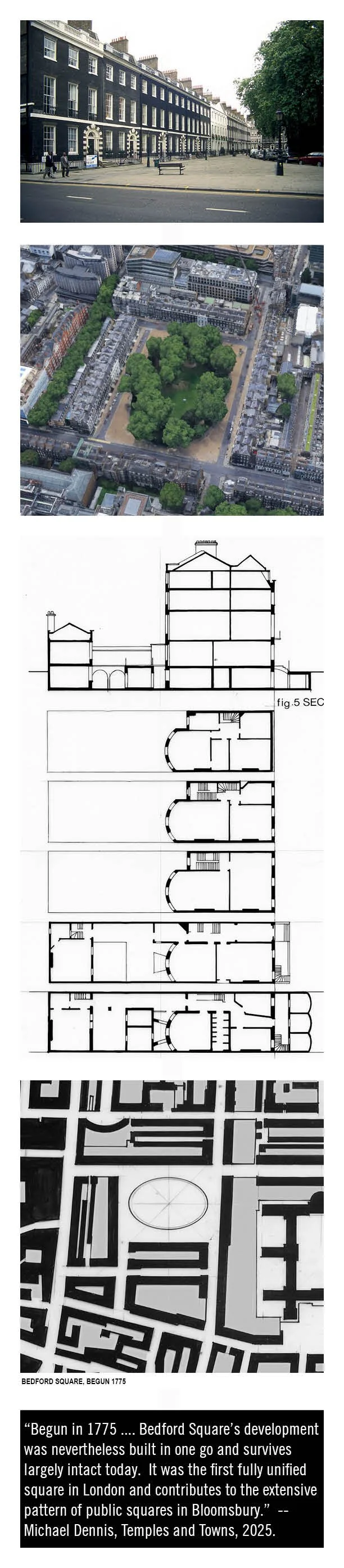
TOP Image: Bedford Square, London. Photograph. Wikimedia Commons.
MIDDLE 1 Image: Google Earth. Satellite imagery of Bedford Square, London. © Google.
MIDDLE 2 Image: Dennis, M. (2025). Bedford Square section and townhouse plans. In Temples and Towns: The Making of Urban Civilization.
MIDDLE 3 Image: Dennis, M. (2025). Bedford Square urban plan. In Temples and Towns: The Making of Urban Civilization.
BOTTOM Image: Paraphrased from Michael Dennis, Temples and Towns: The Making of Urban Civilization (2025).
DRAWN BY ARCHITECTS The estate plans were drawn by architects, which mostly entailed subdivision of large properties into smaller ones (mostly residential townhouse lots) that were then sold to developers who then hired architects to design the buildings on them.
Political economy came into its own as a quasi-scientific field of study in the person of Francois Quesnay (France, 1694-1774) a contemporary of Smith. Quesnay introduced the theory of an ideal society with an economy governed by “natural order”, that is, a rational and self-regulating system rooted in natural law (like physics and biology), meaning established by nature and not by us.
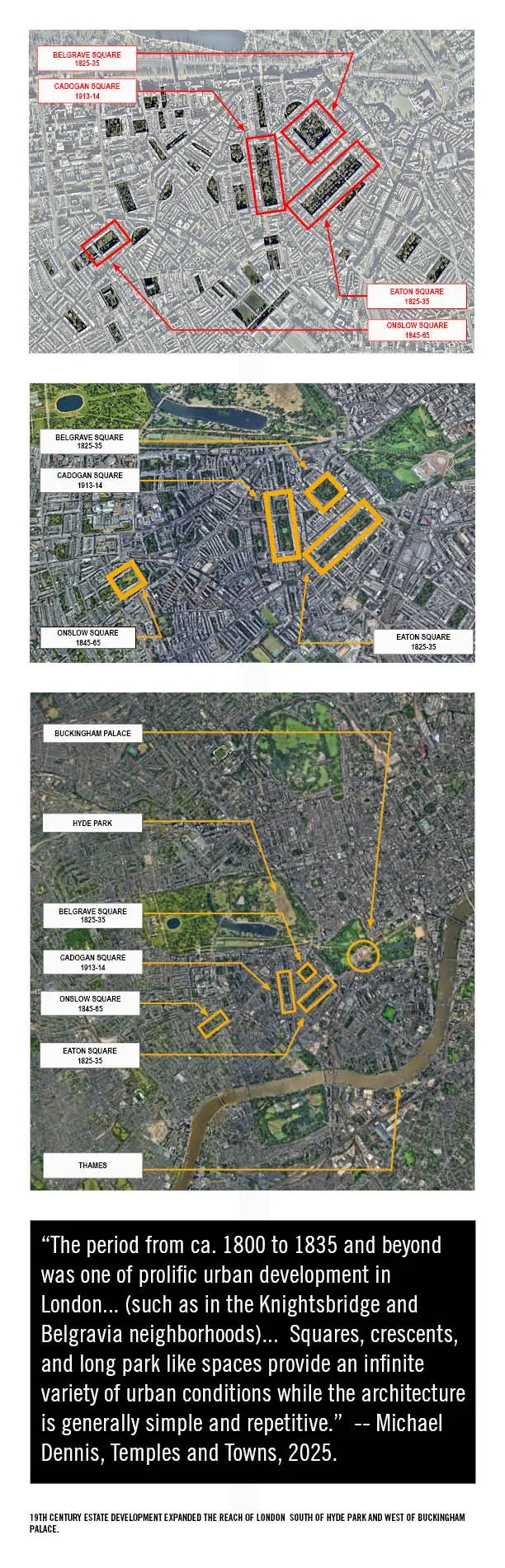
TOP Image: Google Earth. Satellite imagery of Belgravia, London, showing Belgrave Square, Eaton Square, Cadogan Square, and Onslow Square. © Google.
MIDDLE Image: Google Earth. Satellite imagery of Belgravia, London. © Google.
BOTTOM Image: Google Earth. Satellite imagery of Central London. © Google.
BOTTOM Image: Paraphrased from Michael Dennis, Temples and Towns: The Making of Urban Civilization (2025).
ENDURING VALUES Some of the most famous and sought after and therefore expensive and affluent neighborhoods in the world are those that were developed on the estates surrounding the City of London in the 18th and 19th centuries.
Shared moral values, ethics, standards of behavior and norms may have been so taken for granted in 18th century Europe as to seem trivial to Quesnay, if a little less so Smith. In “Moral Sentiments” Smith argues that what we call the market cannot function properly in the absence of both our individual interests and our shared values (or “sentiments”)—although exconced within an elite, monocultural environment such as 18th century Scotland he may have overestimated the capacity for shared values to balance individual interests.
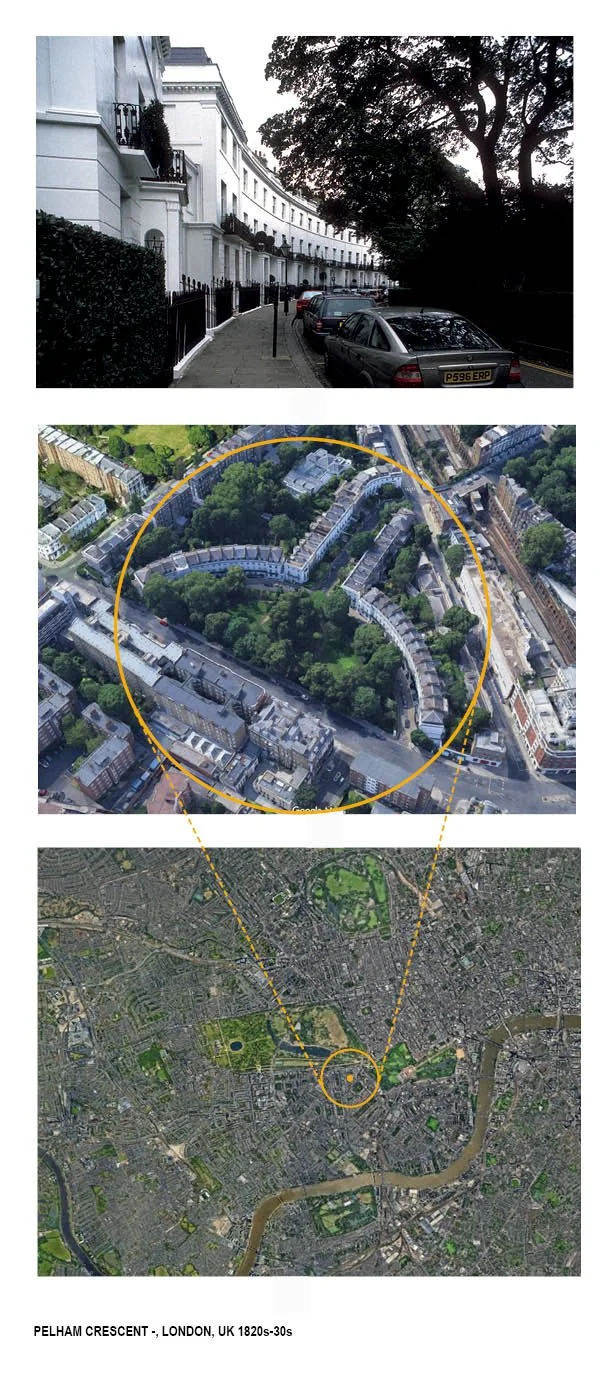
TOP Image: Photograph of Pelham Crescent, London. Wikimedia Commons.
MIDDLE Image: Google Earth. Aerial imagery of Pelham Crescent, London. © Google.
BOTTOM Image: Google Earth. Satellite imagery of Central London, highlighting the location of Pelham Crescent. © Google.
SHAPED TO SHAPE Adopting principles established in 16th century Italy the buildings that made up the neighborhoods took their shape primarily to shape the spaces upon which they faced.
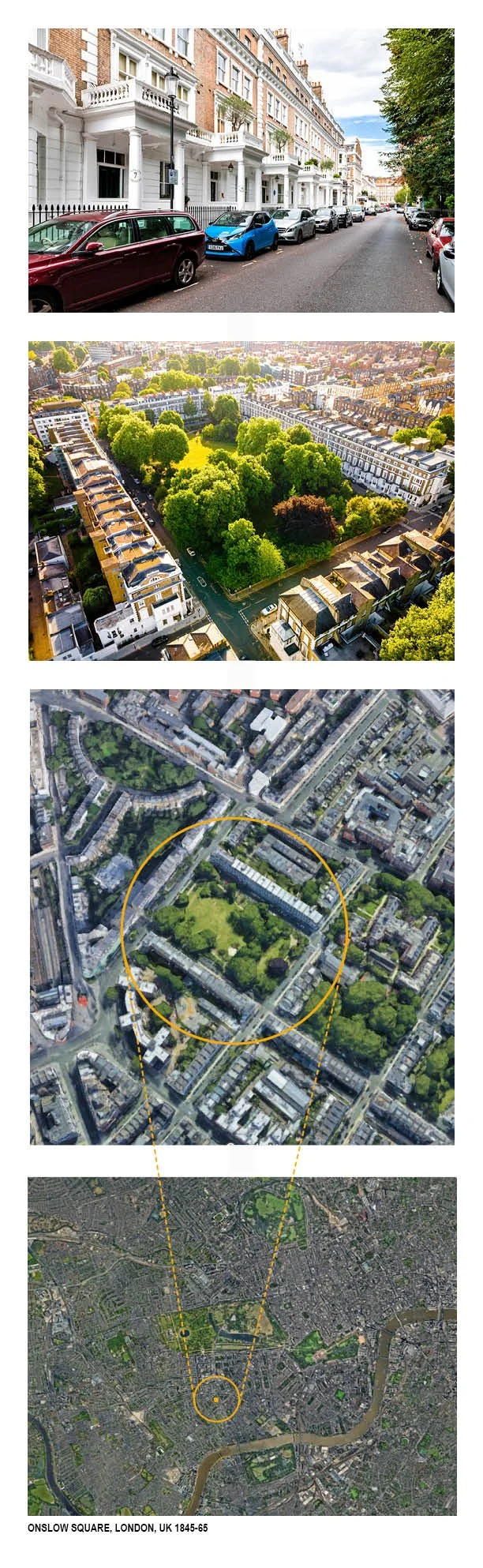
TOP Image: Photograph of Onslow Square, London. Wikimedia Commons.
MIDDLE 1 Image: Aerial photograph of Onslow Square, London. Wikimedia Commons.
MIDDLE 2 Image: Google Earth. Aerial imagery of Onslow Square, London. © Google.
BOTTOM Image: Google Earth. Satellite imagery of Central London, highlighting the location of Onslow Square. © Google.
PIAZZA INTO SQUARE In lieu of the mostly paved “piazza” of Italy, the neighborhood “square” in London is usually a park.
Nevertheless, his famous quote about the “invisible hand” (mentioned in both “Moral Sentiments” and “Wealth of Nations”) is a metaphor for how it is the alignment of individual interests and shared values that makes a market work best, and in such a way that it seems to work naturally (that is, steered by an “invisible hand”). But for Smith the market is not natural, it is us.

TOP Image: Rockefeller Center, New York City. Photograph. Wikimedia Commons.
MIDDLE 1 Image: Aerial view of Rockefeller Center, New York City. Google Earth. © Google.
MIDDLE 2 Image: Figure illustrating the site plan of Rockefeller Center. Adapted from Dennis, M. (2025). Temples and Towns: The Making of Urban Civilization.
BOTTOM Image: Adapted from Michael Dennis, Temples and Towns: The Making of Urban Civilization (2025).
LONG TERM VALUES Rockefeller Center in mid-town New York, like the London Estates, was a privately funded project which like the London Estates was both a profit-making endeavor and one which recognized that its returns would materialize only in the long term.
Smith has been (both inadvertently and purposely) misinterpreted over the centuries, most notably in the last by characters such as Milton Friedman, who used Smith to justify his case that markets should be “free,” that they’re always right and governments should butt out; and, later Peter Drucker who commanded that the only purpose of any business shall be to “maximize profit,” regardless of what it makes or service it delivers.
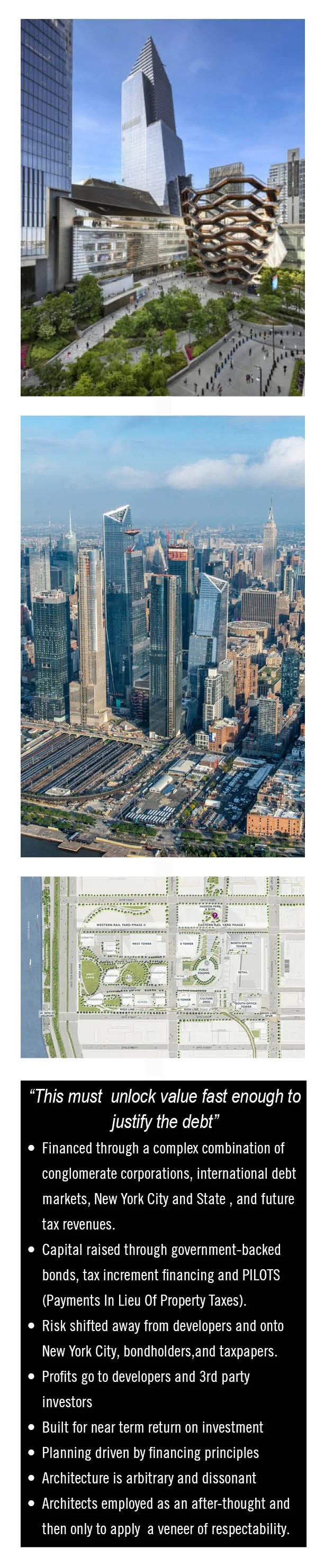
TOP Image: Hudson Yards, New York City. Photograph. Related Companies.
MIDDLE 1 Image: Aerial view of Hudson Yards, New York City. Wikimedia Commons.
MIDDLE 2 Image: Hudson Yards Master Plan. Related Companies and Oxford Properties.
BOTTOM Image: Adapted from Michael Dennis, Temples and Towns: The Making of Urban Civilization (2025).
SHORT TERM VALUES Hudson Yards on the upper west side of New York required multiple third party sources of funding, most of which demand short term returns (typically five years) on their investment, such demands were reflected in both the urban design plan and architecture of the development.
While Quesnay and Smith were inventing political economic theory, one of the first instances of building buildings almost entirely for purposes of making money took place. The London estate developments of the 18th and 19th centuries were early examples of what we now call “speculative real estate development” the principal mechanism by which cities since the 19th century have grown.
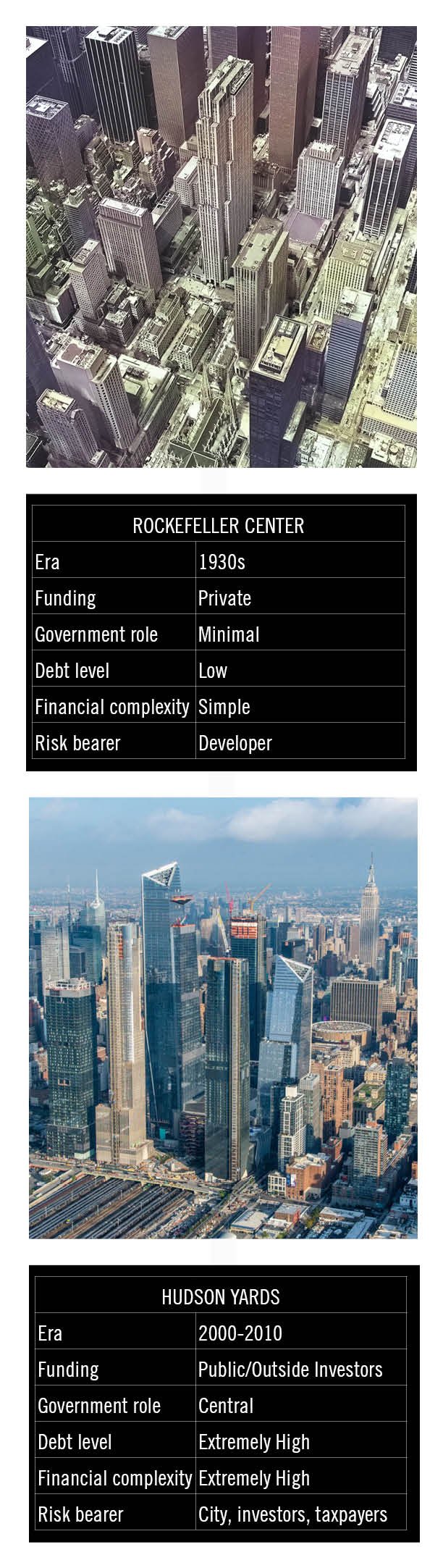
TOP Image: Aerial view of Rockefeller Center, New York City. Google Earth. © Google.
MIDDLE 1 Image: Adapted from Dennis, M. (2025). Temples and Towns: The Making of Urban Civilization.
MIDDLE 2 Image: Aerial view of Hudson Yards, New York City. Wikimedia Commons.
BOTTOM Image: Adapted from Dennis, M. (2025). Temples and Towns: The Making of Urban Civilization.
VANISHING VALUES The values that drove the plan and design of Rockefeller Center a century ago -- those that saw development within a city not only as an economic project, but as a form of neighborhood and city building—had by the time of the Hudson Yards long vanished.
Their designs were guided by norms, evolved over centuries of experience, probably so taken for granted in 18th century Europe as to seem trivial. The neighborhoods they produced are now some of the most affluent neighborhoods in London, and, to say the least, profitable. But conceived within the context of shared values now considered outdated and out-of-touch, they bear little resemblance to what development looks like today.
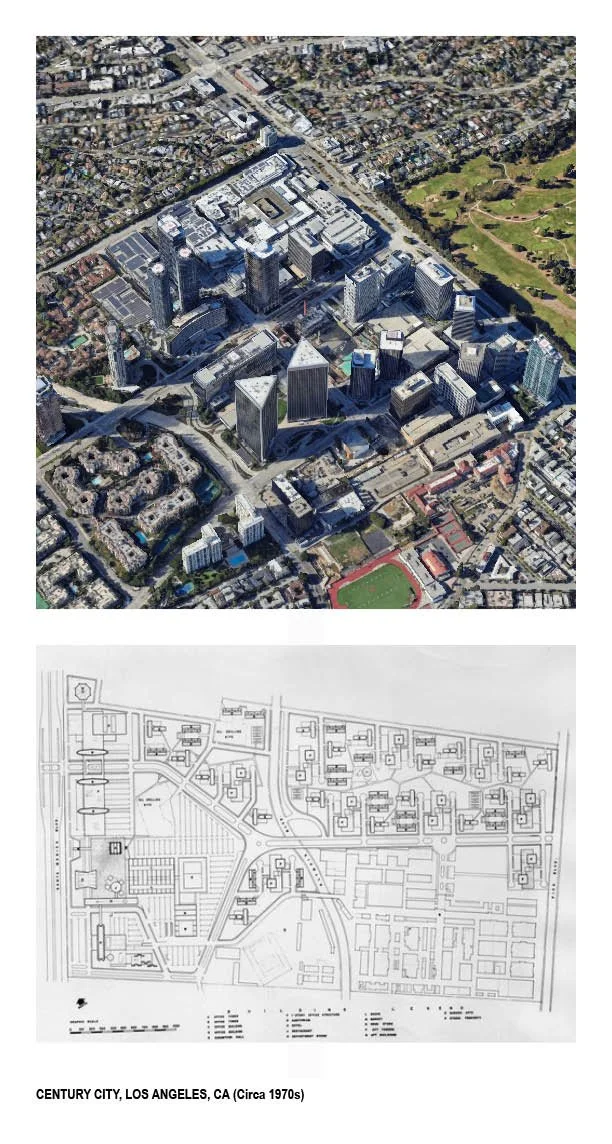
TOP Image: Google Earth. Aerial imagery of Century City, Los Angeles, California. © Google.
BOTTOM Image: Century City Master Plan (c. 1970s). Adapted from Dennis, M. (2025). Temples and Towns: The Making of Urban Civilization.
CYNICAL VALUES Like the London Estates, Century City in Los Angeles, was initiated by a cash poor, land rich private player (the movie studio 20th Century Fox) but unlike the London Estates and more like Hudson Yards, Century City was designed as a citadel, almost entirely isolated from its surroundings.
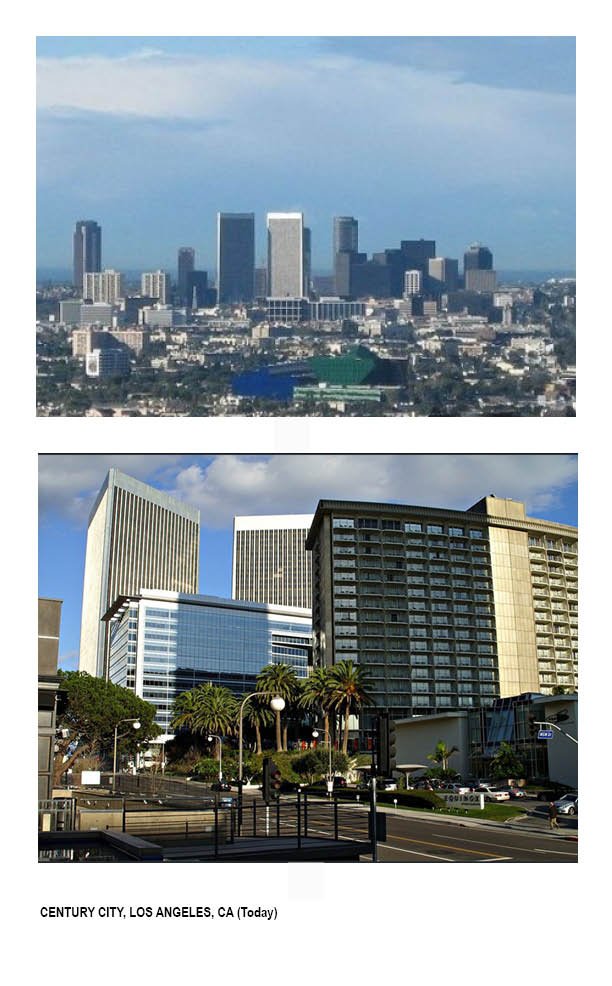
TOP Image: Century City skyline, Los Angeles, California. Wikimedia Commons.
BOTTOM Image: Century City, Los Angeles, California. Photograph. Wikimedia Commons.
MARKET DRIVEN NIHILISM Like Hudson Yards and countless real estate developments across the nation Century City could be anywhere in the nation as it bears no relationship to where it is.
And yet, it is increasingly hard to deny that what the market builds now (tract houses and apartment blocks) is not itself outdated and out-of-touch. There may have been a time when what gets built now was in alignment with what people value, but as the real estate values of those neighborhoods in London show, apparently not anymore. Why?
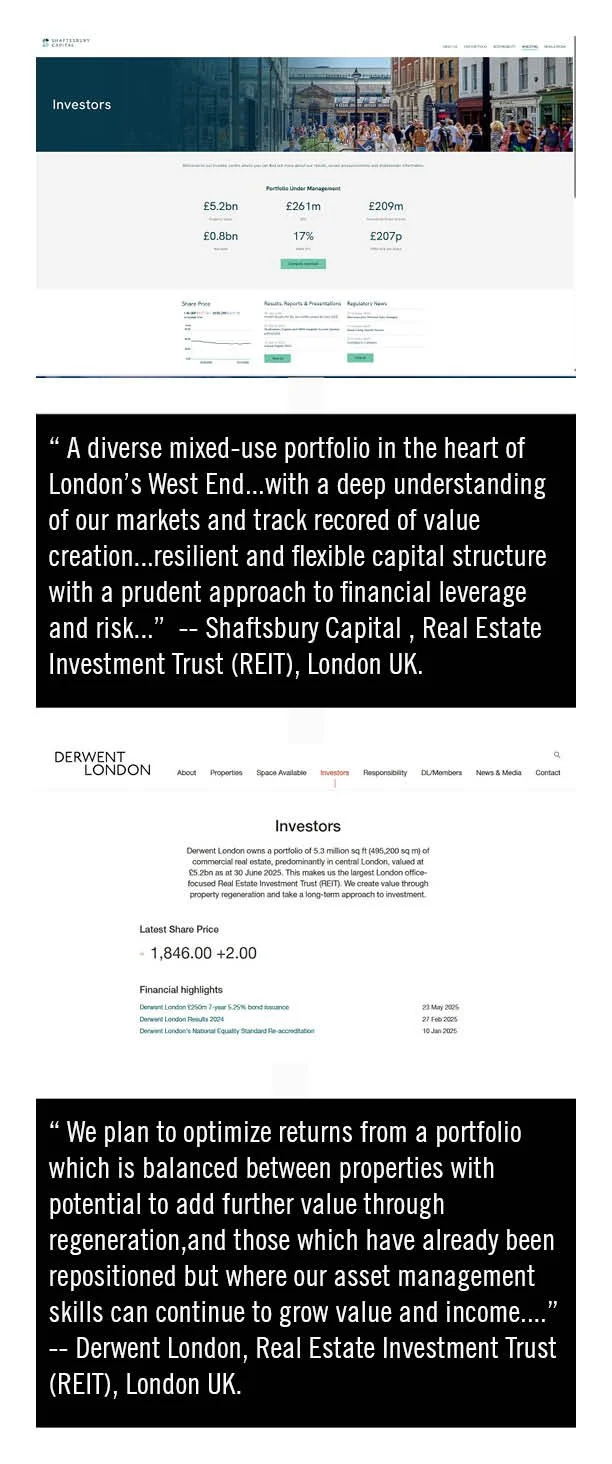
TOP Image: Shaftesbury Capital PLC. Investors. https://www.shaftesburycapital.com/investors/
MIDDLE 1 Image: Adapted from Shaftesbury Capital PLC. Investors. https://www.shaftesburycapital.com/investors/
MIDDLE 2 Image: Derwent London PLC. Investors. https://www.derwentlondon.com/investors/
BOTTOM Image: Adapted from Derwent London PLC. Investors. https://www.derwentlondon.com/investors/
EXTRACTION MASQUERADING AS INVESTMENT In an extractive global economy third party investors seek out facilitators such as investment banks who through mechanisms such as Real Estate Investment Trusts (REITs) provide opportunities to put their wealth “to work”, meaning generate income from Returns on Investment (ROIs)—all entirely removed from the real estate development that generates the ROI.
What has happened to the real estate market since the 18th and 19th centuries and perhaps only in the last and this one is what economists call its” financialization”. For developers “free market” development is as it has been since the era of the London estates a means to make a profit only now unlike the London estate ventures only mostly for third party investors and stockholders. It is the extraction of profit from the venture by those not involved in or affected by it that matters most. The market is, like the London estates were, about money, but unlike them, little else.
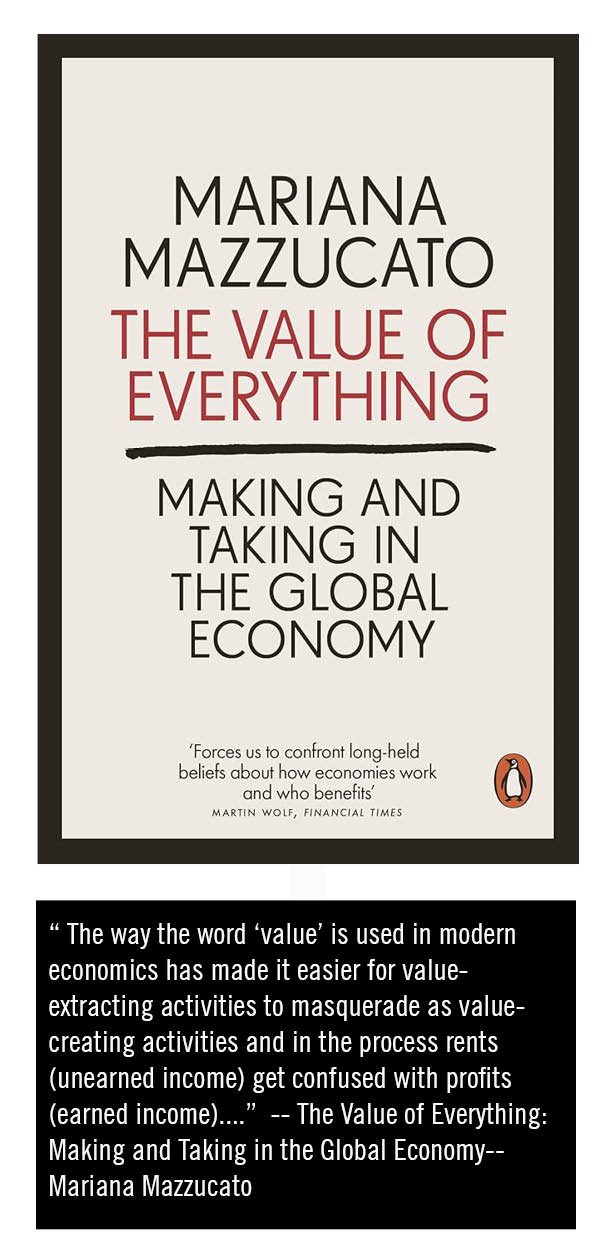
TOP Image: Mazzucato, M. (2018). The Value of Everything: Making and Taking in the Global Economy. Penguin Books.
BOTTOM Image: Quoted from Mazzucato, M. (2018). The Value of Everything: Making and Taking in the Global Economy. Penguin Books.
MISALIGNED MARKET No part of our economy illustrates better what this author claims than the current state of the real estate market, which given the most exaggerated and extractive shape it has taken since is so out of alignment with how most people want to live still determines how they live.
Having devolved into a mindless profit maximizer for uninvolved third-party investors, the real estate market has become, like the paperclip maximizer, out of alignment with deeply held, if sometimes dormant and not always expressed, shared human values. That the London estates are some of the most expensive neighborhoods in London and yet no one is building or offering anything remotely like them anywhere ought to provide a clue that developers’ understanding of the market has gone awry--- their blind and distorted assumptions merely confirmed by buyers who, in the absence of anything other than what is on offer, will take what they can get.
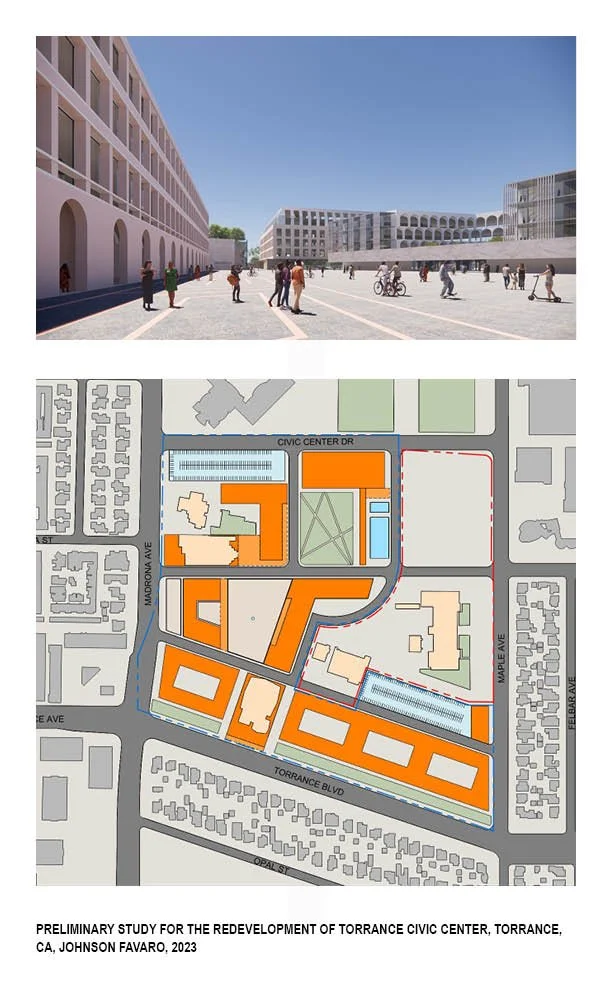
REALIGNED MARKET Clearly the real estate market has so lost itself that only by recapturing classical principles of urban design with their emphasis on the coherency and utility of spaces between buildings and the diversity of residential arrangements within buildings drawn and enforced by architects alone will we ever recover from the mess of the last 100 years. (Study for Redevelopment of Torrance Civic Center, Torrance, CA, Johnson Favaro 2023).