
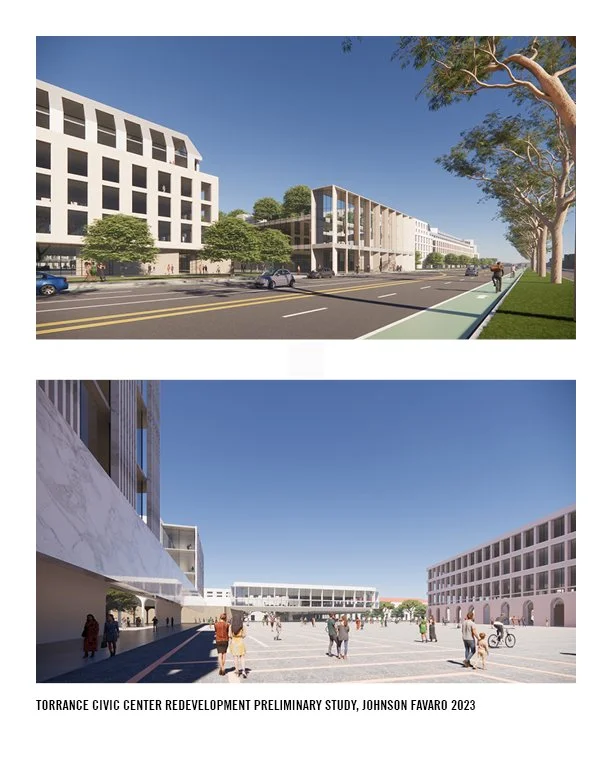
WHAT REAL PLANNING LOOKS LIKE What makes a center a center is its central role in the daily life of people, not just that it centralizes a bunch of services—governmental, commercial or otherwise. (Torrance Civic Center Redevelopment, Preliminary Study, Johnson Favaro, 2023)
Not long ago an associate in our office, a parent of two young children, felt he had no option but to secure a house with a yard within reasonable distance of our office so his children could safely run around outside of the house -- that is, in a yard. He has managed to find a place, but its cost is burdensome. Meanwhile, younger associates are having to live with extended families or gang up with two or three friends in apartments.
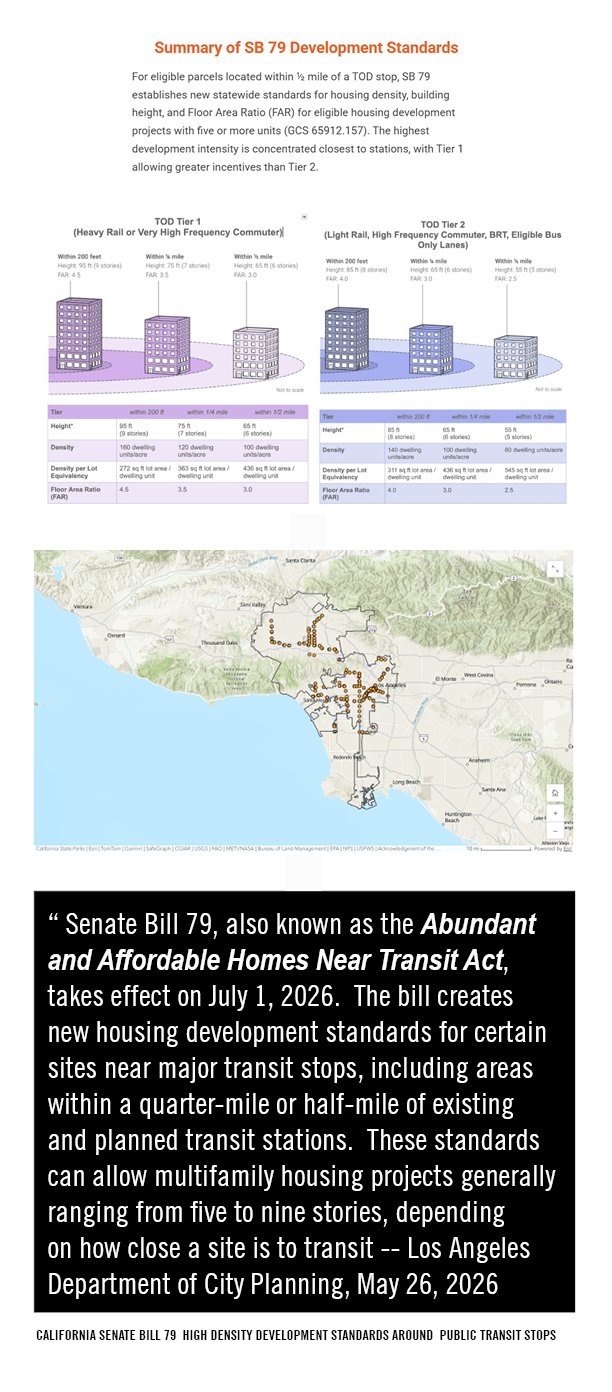
PLANNING WITH WORDS The State of California has passed several laws that will override local objections to more housing on less land within existing neighborhoods without any consideration for what kinds of environments such projects will in their accumulation leave behind.
TOP & MIDDLE Images: Los Angeles Department of City Planning. (2026). SB 79 Development Standards and Transit-Oriented Development Map. BOTTOM Text: Adapted from Los Angeles Department of City Planning, Senate Bill 79: Abundant and Affordable Homes Near Transit Act (May 26, 2026).
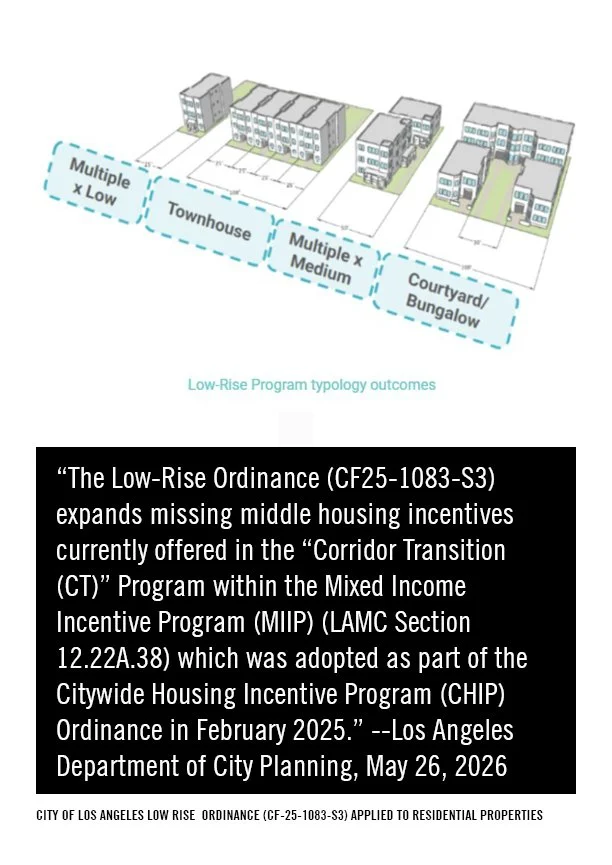
PLANNING IN BITS AND PIECES Despite recent measures to increase so-called “missing middle” homes (neither houses nor apartments) within existing neighborhoods the results have been modest at best for reasons that are obvious.
TOP Image: Los Angeles Department of City Planning. (2026). Low-Rise Program Typology Outcomes. BOTTOM Text: Adapted from Los Angeles Department of City Planning, Low-Rise Ordinance (CF 25-1083-S3) (May 26, 2026).
It has been a generation or two that Los Angeles has become an expensive place to establish a home. There are now not enough places to live in a dynamic city that is still attracting newcomers from around the world. That we have a “housing affordability problem” has become our elected officials’ cause-celebre.
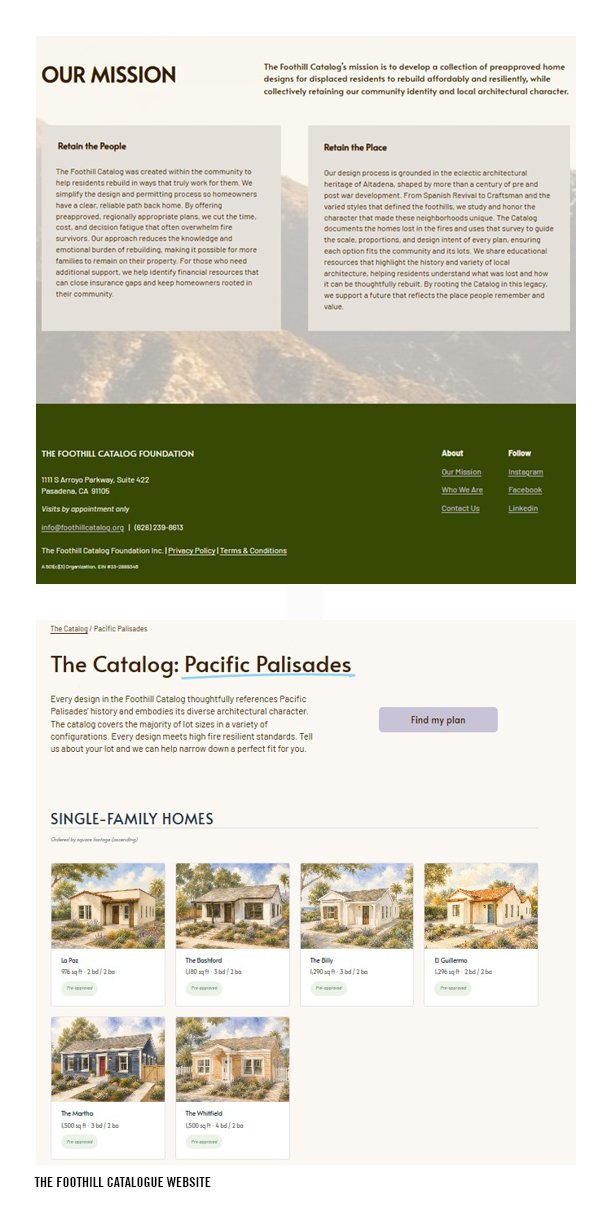
NO PLANNING AT ALL The aftermath of the Pacific Palisades and Altadena fires rendered sadly transparent our political and community leaders’ stunning lack of imagination and whose best thoughts seem to be “let’s replicate what was there” – seemingly with little awareness that what was there is why it is no longer there.
TOP & BOTTOM Images: The Foothill Catalog Foundation. Foothill Catalog Website.
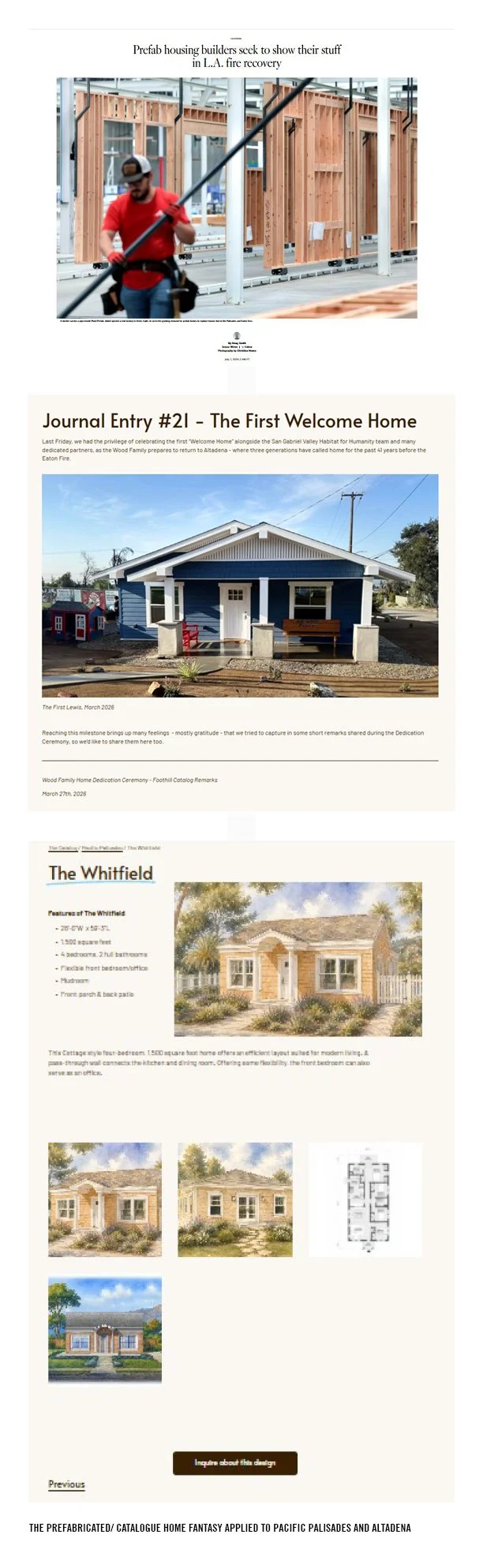
PERPETUAL HOUSES ON THE PRAIRIE That we in the 21st century insist on perpetuating the bad habits of the 20th century is by now unforgivable.
TOP Image: Los Angeles Times. (July 1, 2026). “Prefab housing builders seek to show their stuff in L.A. fire recovery.” MIDDLE Image: The Foothill Catalog Foundation. (2026). “Journal Entry #21 – The First Welcome Home.” Foothill Catalog website. BOTTOM Image: The Foothill Catalog Foundation. (2026). “The Whitfield.” Foothill Catalog website.
The underlying reasons for the scarcity of housing are much discussed and two-fold: too much regulation (design and environmental review, NIMBYism, etc.) and too much money (land, carrying and construction costs).
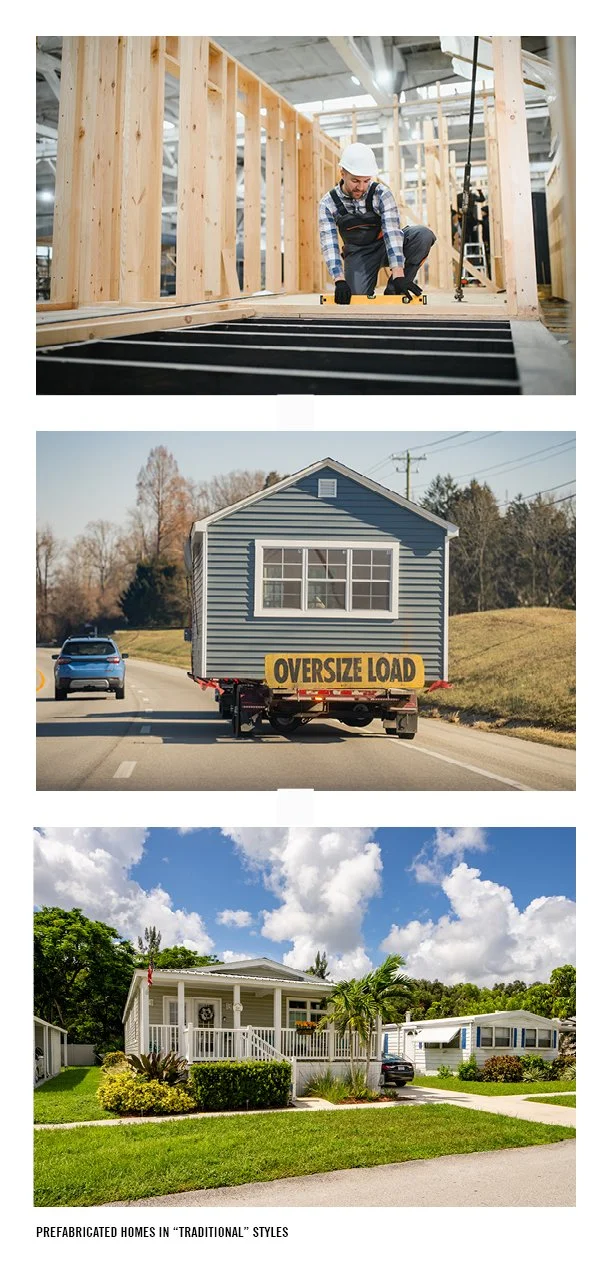
MANUFACTURING THE MYTH The “industrialization” of housing has amounted to little more than the reliance on costly and inefficient craft-based construction off-site that then must be inefficiently and at a high cost transported on site.
ALL Images: Shutterstock.
Government can, with its limited tools and blunt instruments, address regulations and environmental review on the theory that by easing restrictions on land-use more housing will naturally follow. Several laws have recently passed in California with the intention of providing for more housing on private properties within existing neighborhoods (overriding local NIMBYism).
Land, carrying and construction costs are, however, at the mercy of both global and local financial and labor markets. Land is a limited resource even in Los Angeles and that lots of people want to live on it necessarily drives up its cost. Meanwhile, federal interest rates (carrying costs) are shackled to our vagarious larger economy with little that any of us can do about it.
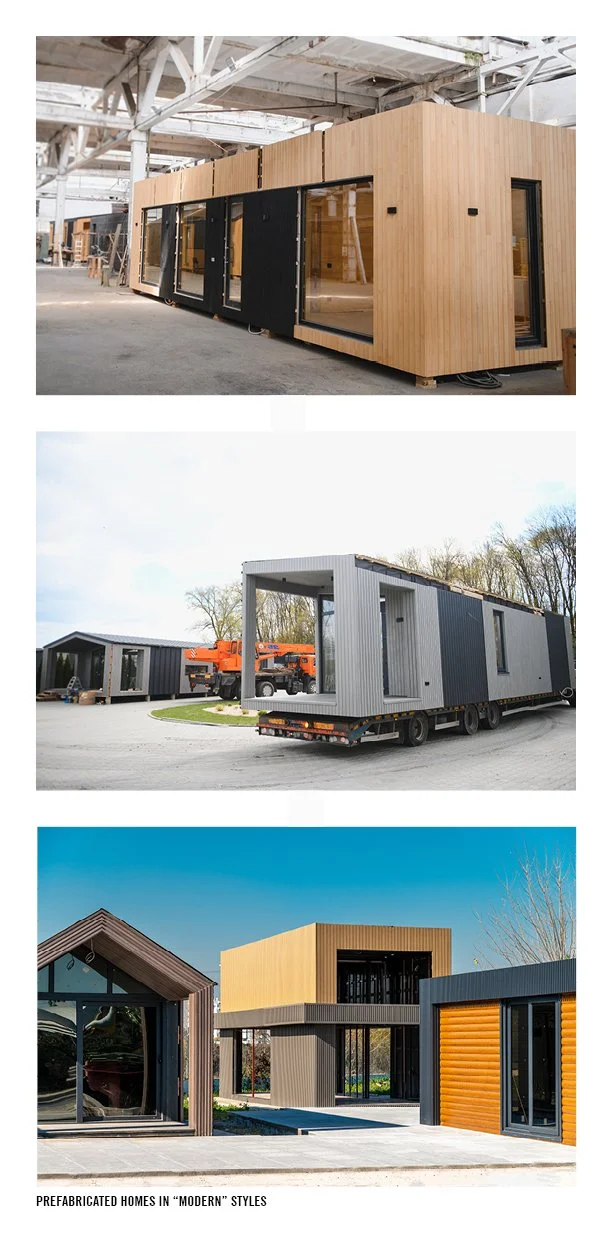
REFASHIONING THE MYTH By re-styling a retrogressive industry we somehow think we are modernizing it.
ALL Images: Shutterstock.
With land and carrying costs out of our control, we instead focus on construction costs, specifically labor costs, specifically by reducing not the cost of labor but the labor itself. For over a century we have indulged in fantasies of manufactured (or “prefabricated”) modular housing on the theory that we could make a house the way we make a car (Henry Ford tried). More recently we have pivoted to large-scale 3-D printing on the promise that it will finally revolutionize the economy of housing production.
None of this has or will work.
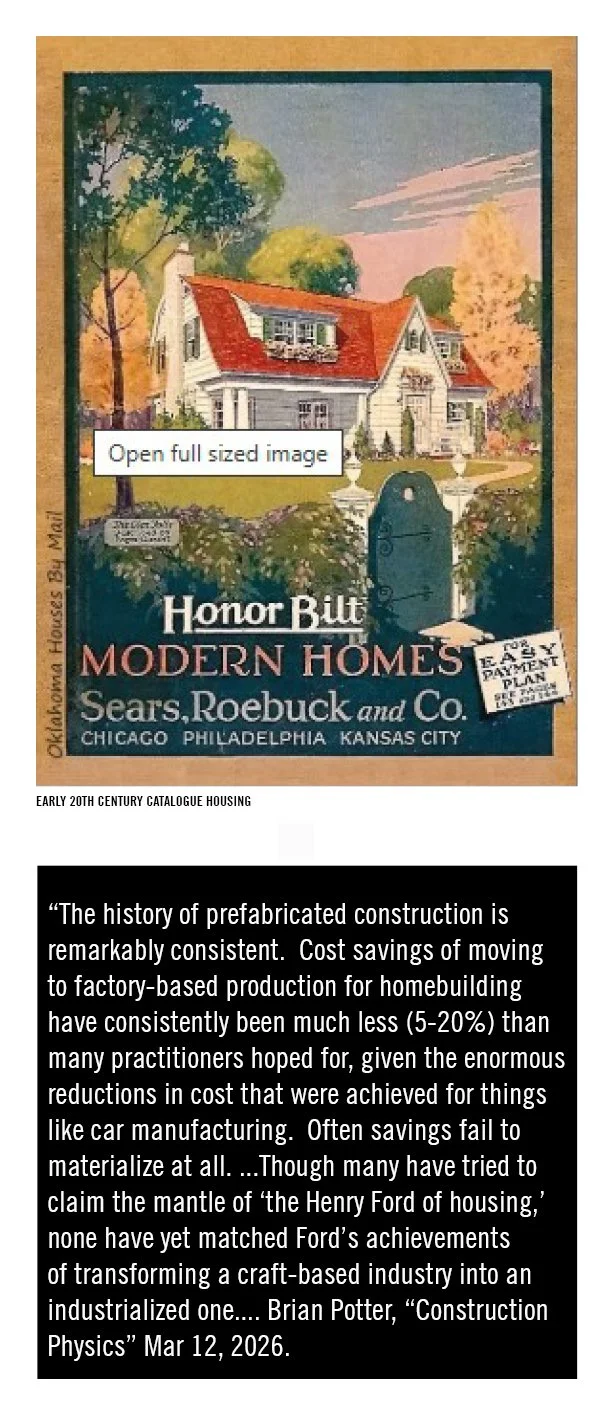
20TH CENTURY DELUSION For over a century catalogued templates and prefabricated products have lulled us into thinking that we need not ever build cities, just homes.
TOP Image: Sears, Roebuck and Co. Honor Bilt Modern Homes catalog. Early 20th century. BOTTOM Text: Brian Potter. Construction Physics. “The History of Prefabricated Construction.” March 12, 2026.
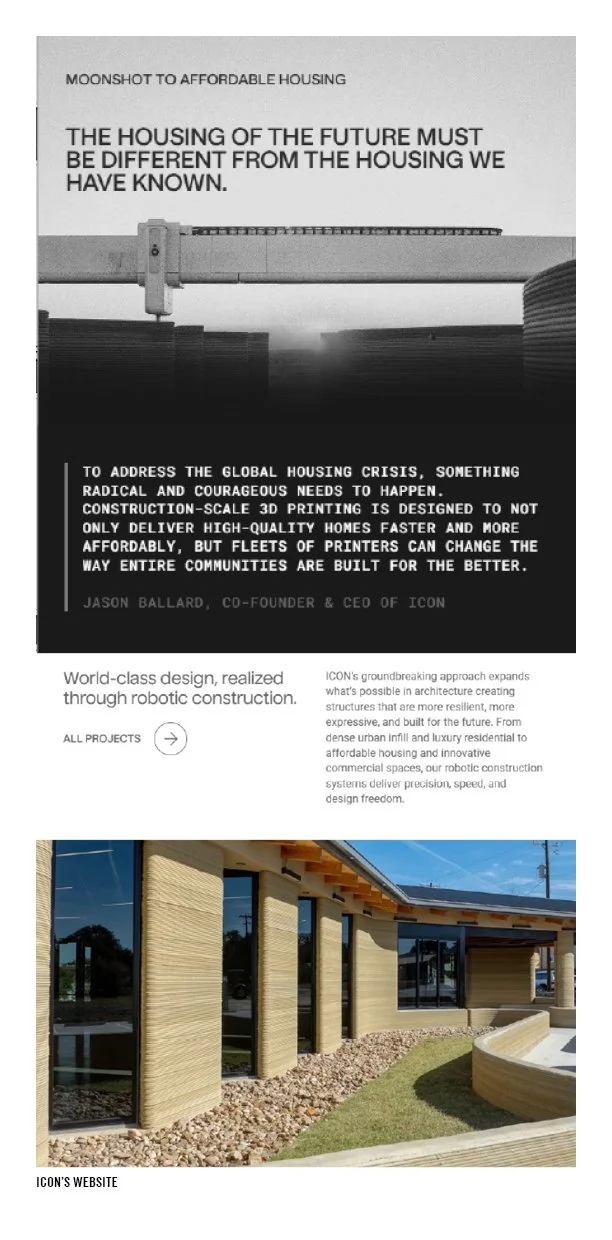
21ST CENTURY DELUSION Not unlike those made a century ago wild claims are now made that new more efficient and heretofore unheard-of technologies will somehow solve the housing affordability issue.
TOP Image & Text: ICON. “Moonshot to Affordable Housing.” ICON website. MIDDLE Text: ICON. “World-class design, realized through robotic construction.” ICON website. BOTTOM Image: ICON. 3D-printed housing project. ICON website.
When landowners realize more can be built on what they own the more valuable they will conclude their land is worth. Land scarcity to them is the source of their wealth (NIMBY ism is about more than racism). Meanwhile, over the last century the cost of construction has risen at almost twice the rate of the larger economy, not because it has gone up relative to everything else, but because the cost of everything else has gone down relative to it.
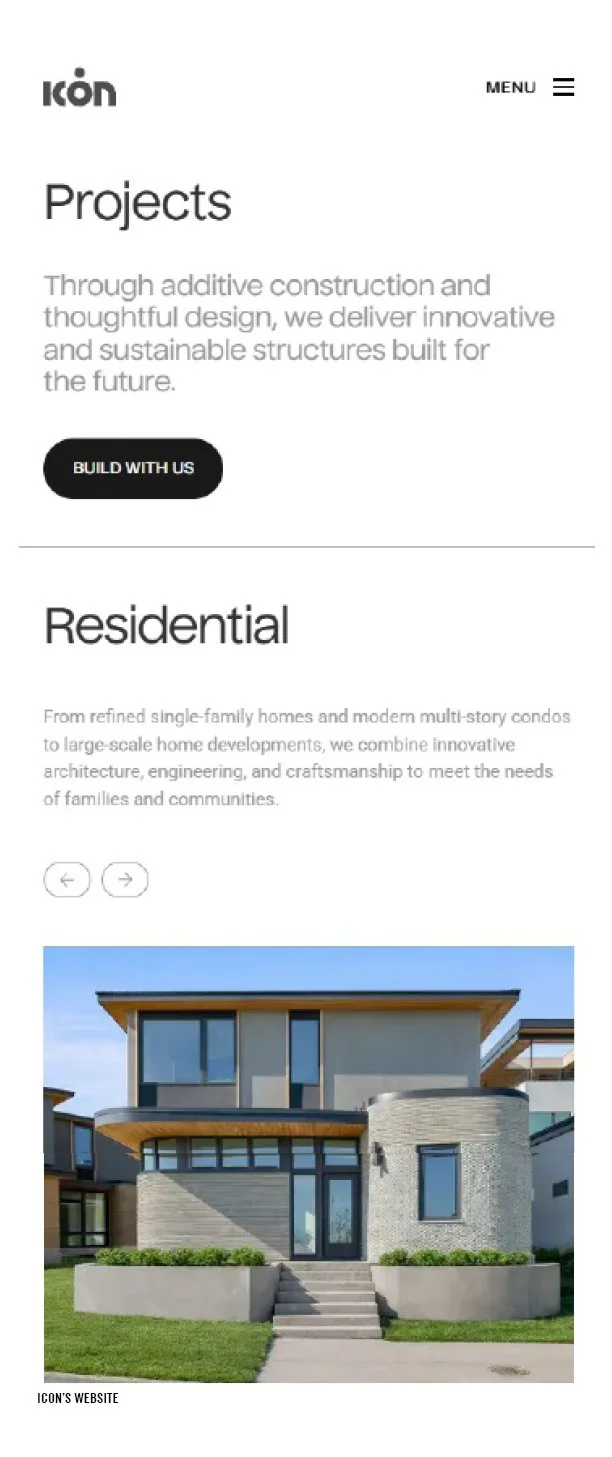
THE SUSTAINABILITY OF BULLSHIT Words such as “sustainability” and “innovative” must now count for nothing having lost all meaning in the context of bad land use behaviors we’ve witnessed for over a century.
TOP Text: ICON. Projects – Residential. ICON website. BOTTOM Image: ICON. Residential 3D-printed home. ICON website.
This is a case of what economists call the “Baumol effect:” While televisions and shoes are manufactured with increasing standardization and efficiency, and now mostly overseas (where labor is cheap) we cannot (or should not) standardize or manufacture an opera, or a string quartet or a Broadway play—neither here nor overseas. Consequently, the cost of dinner out in Los Angeles is equivalent to a new suit because our suit can be made in Vietnam, while our dinner out cannot.
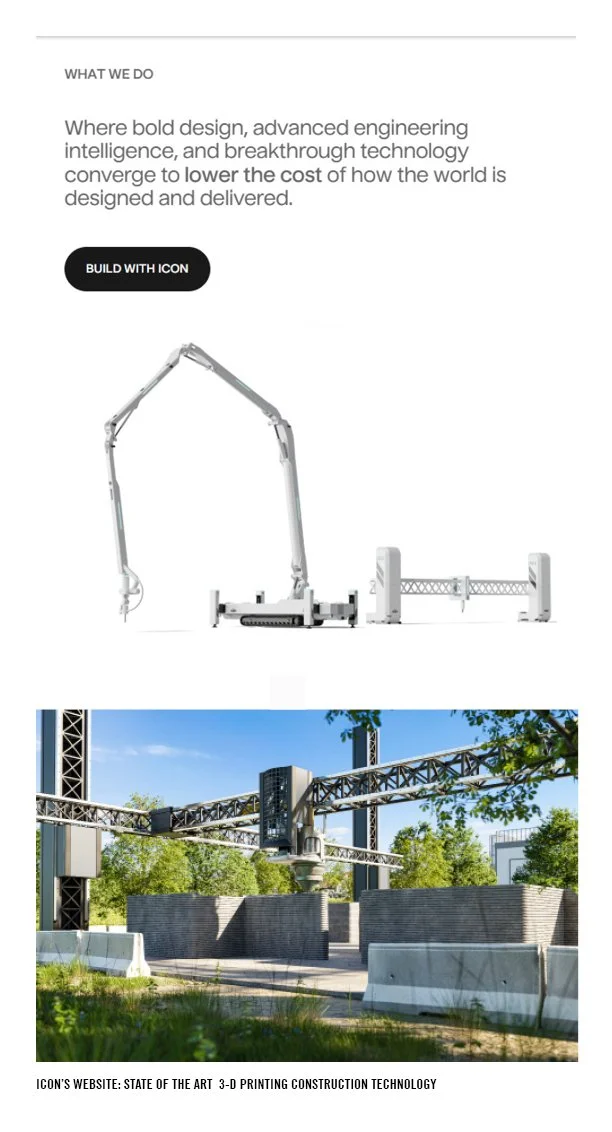
AUTOMATION MISAPPROPRIATION A technology that seeks to extract the craft out of building is doomed to failure for reasons that are endemic to building-- a human act that, like poetry and painting, is uniquely resistant to standardization and industrialization.
TOP Image & Text: ICON. “What We Do.” ICON website. BOTTOM Image: ICON. 3D-printing construction technology. ICON website.
We are deluded when we complain about costs that weigh on the real estate market, because we never question the underlying assumptions of the real estate market. Building buildings has always been expensive and buildings (including those in which our homes reside) are not consumer products. We cannot carry around or wear homes, and we should stop thinking about them as if we can. And we should stop trying to force construction into a manufacturing model by building houses, apartment blocks and towers as if they are.
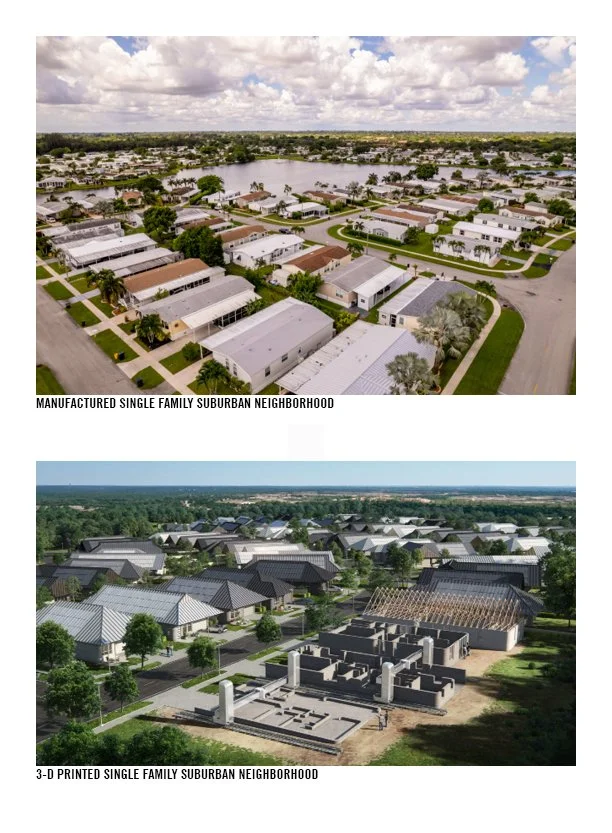
CAMPGROUND OR CITY? Whether prefabricated or printed, a bunch of houses does not a home make.
TOP Image: Manufactured single-family suburban neighborhood. Shutterstock. BOTTOM Image: ICON. 3D-printed single-family residential community. ICON website.
The accumulation of buildings designed and built as if they were standardized, manufactured consumer products with little to no concern for how they are accumulating blinds us to what we are (or rather should be) building—which is (or should be) not homes but a home.
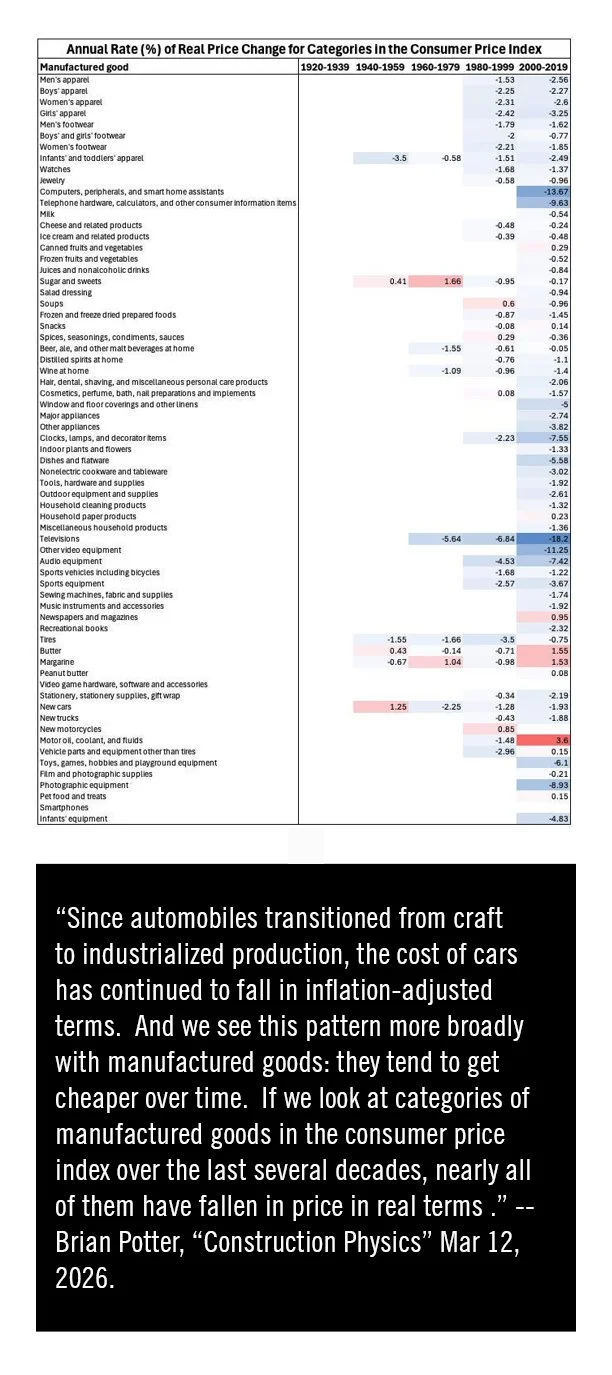
WHY SOME THINGS COST LESS Those things, mainly consumer products, that we have managed to industrialize we also manage to make with ever greater efficiency thus reducing their costs.
TOP Image & BOTTOM Text: Brian Potter, Construction Physics, “The History of Prefabricated Construction” (March 12, 2026).
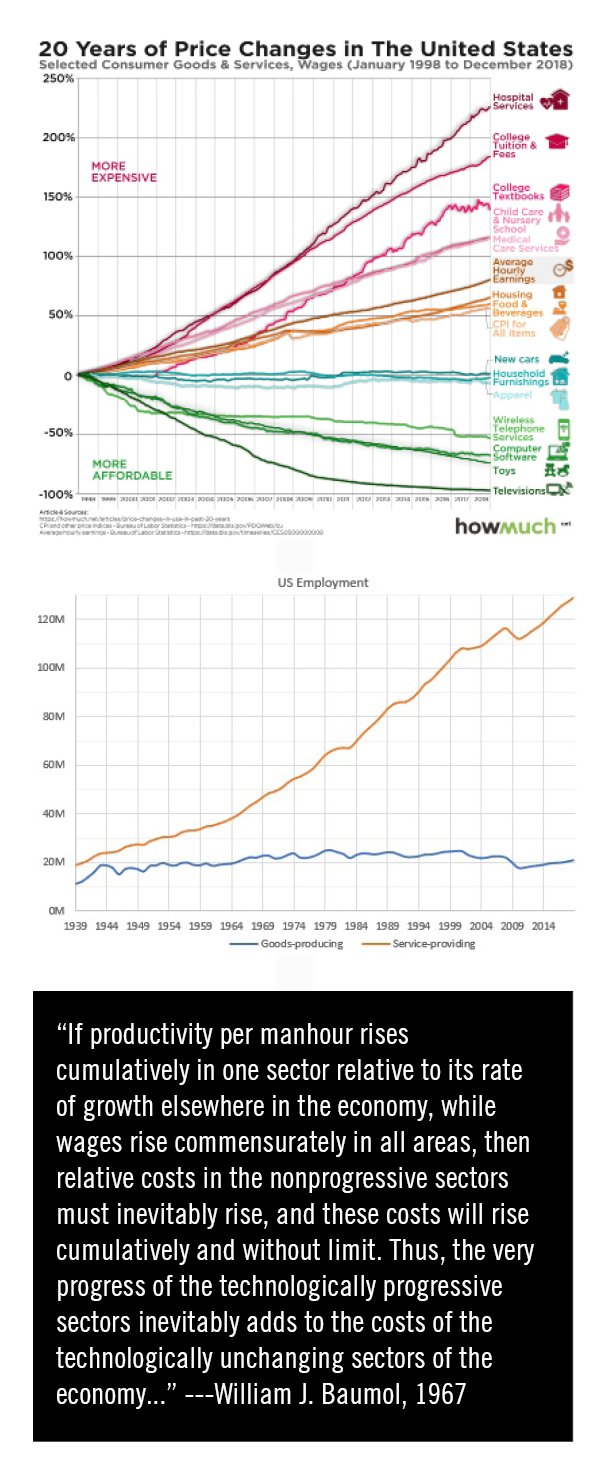
WHY SOME THINGS COST MORE Those things, mainly the products of art and craft, that we have not been able to industrialize seem to greatly increase in cost when they do so only comparatively.
TOP CHART: HowMuch.net, “20 Years of Price Changes in the United States” (1998–2018). MIDDLE CHART: U.S. Bureau of Labor Statistics (BLS), U.S. Employment, Goods-Producing vs. Service-Providing Industries. BOTTOM QUOTE: William J. Baumol, Macroeconomics of Unbalanced Growth: The Anatomy of Urban Crisis (1967).
A city that is a home is more than a bunch of homes. It includes squares, courts, parks, gardens, streets (without cars), mews and alleyways within walking distance of a variety of kinds of places in which to live (large, small and everything in between) that accommodate a variety of kinds of people in proximity with one another. It provides for an array of opportunities for being outside of the home as much as inside—available to everyone, safe and teeming—and in so doing allows each of us to need and want less (such as, for example, a house with a yard).
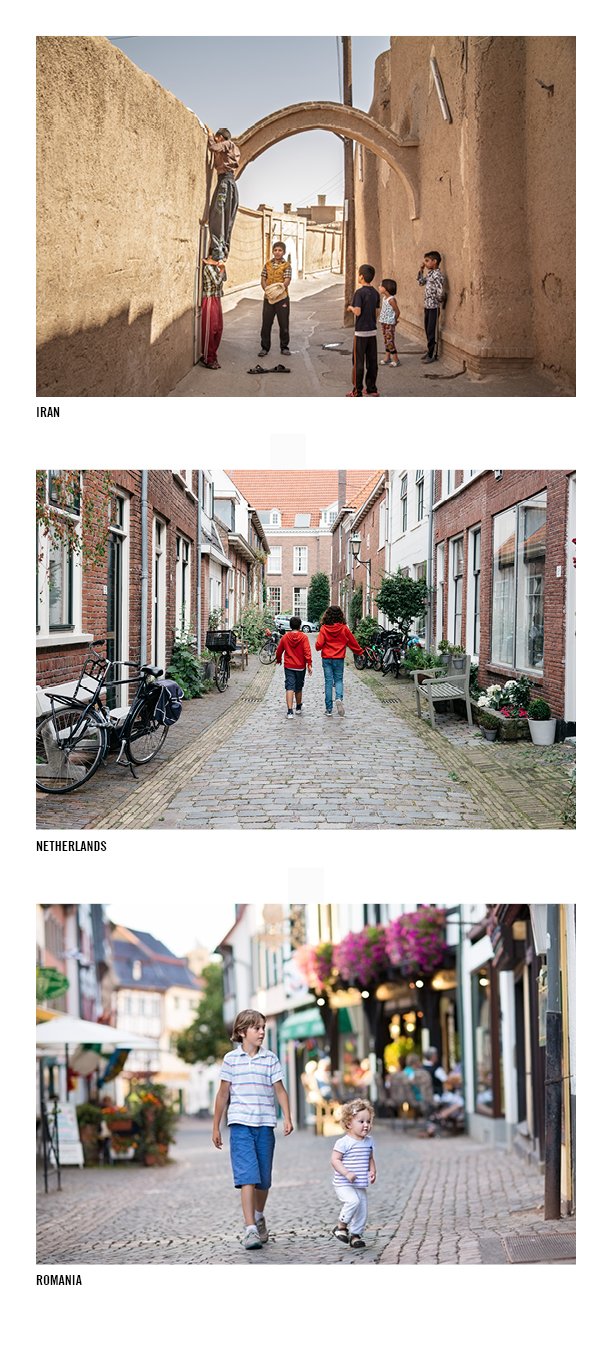
KIDS IN STREETS
ALL Images: Shutterstock.
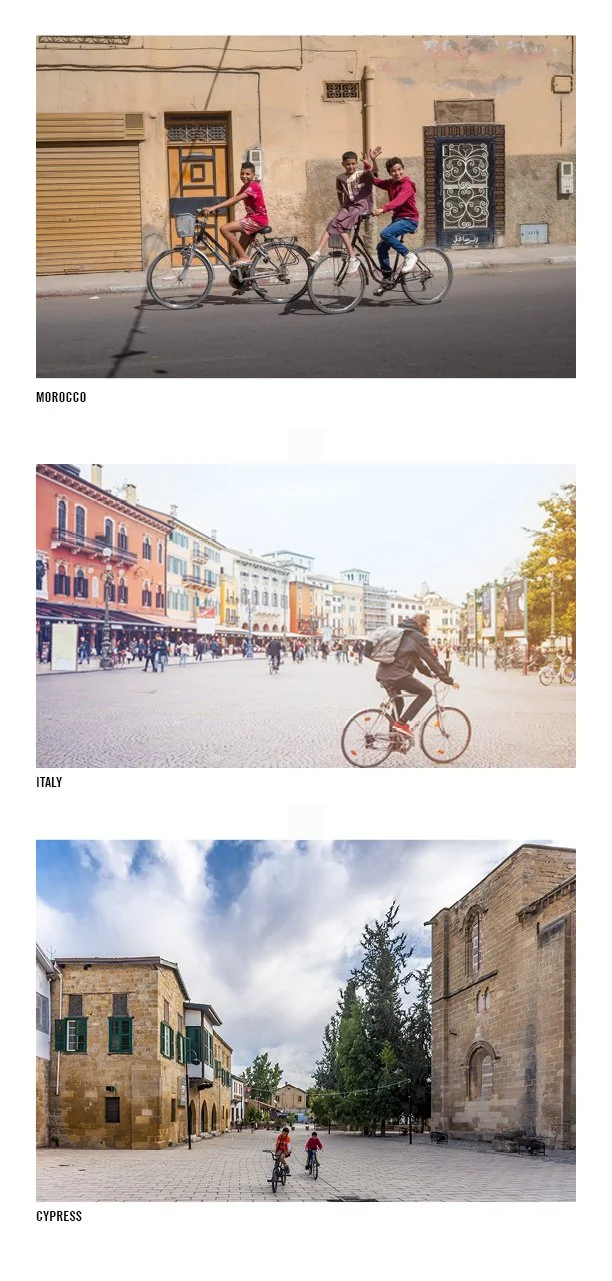
KIDS ON BIKES
ALL Images: Shutterstock.
Too much of our land, both private and public, is single-purposed or underutilized or both. Re-zoning privately held land to accommodate more of what we do not have enough will not work unless we change our attitude toward the development of not only privately held but also publicly held land, too much of which is, stupidly, covered in roads and parking lots.
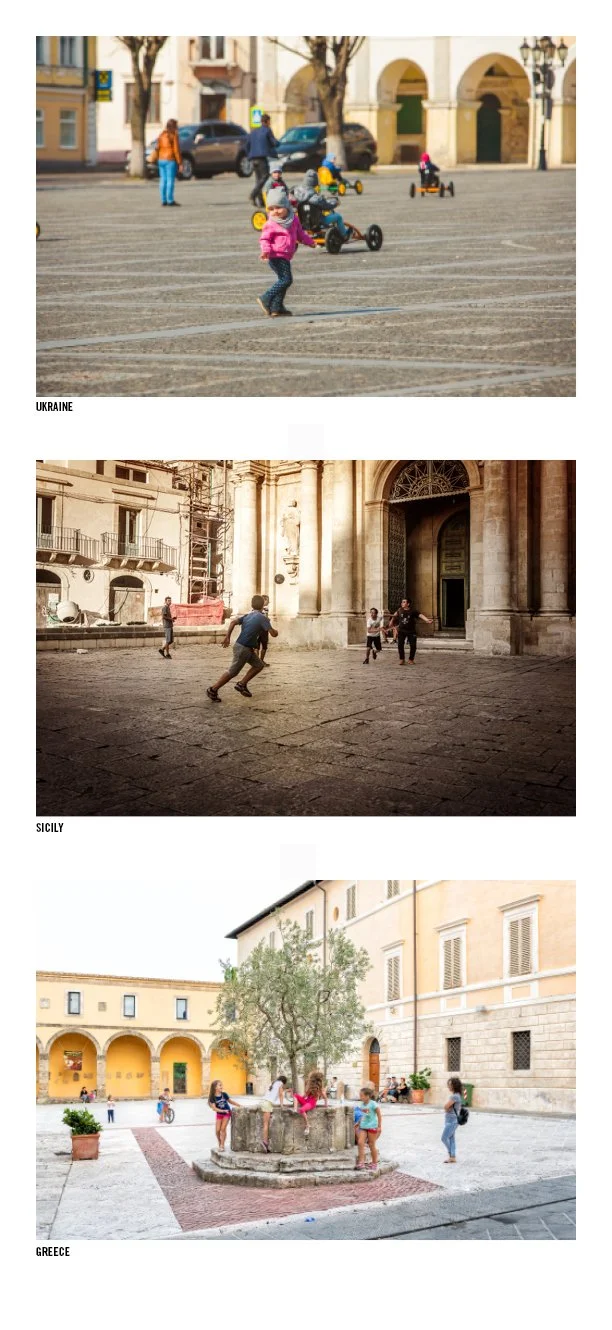
KIDS IN SQUARES
ALL Images: Shutterstock.
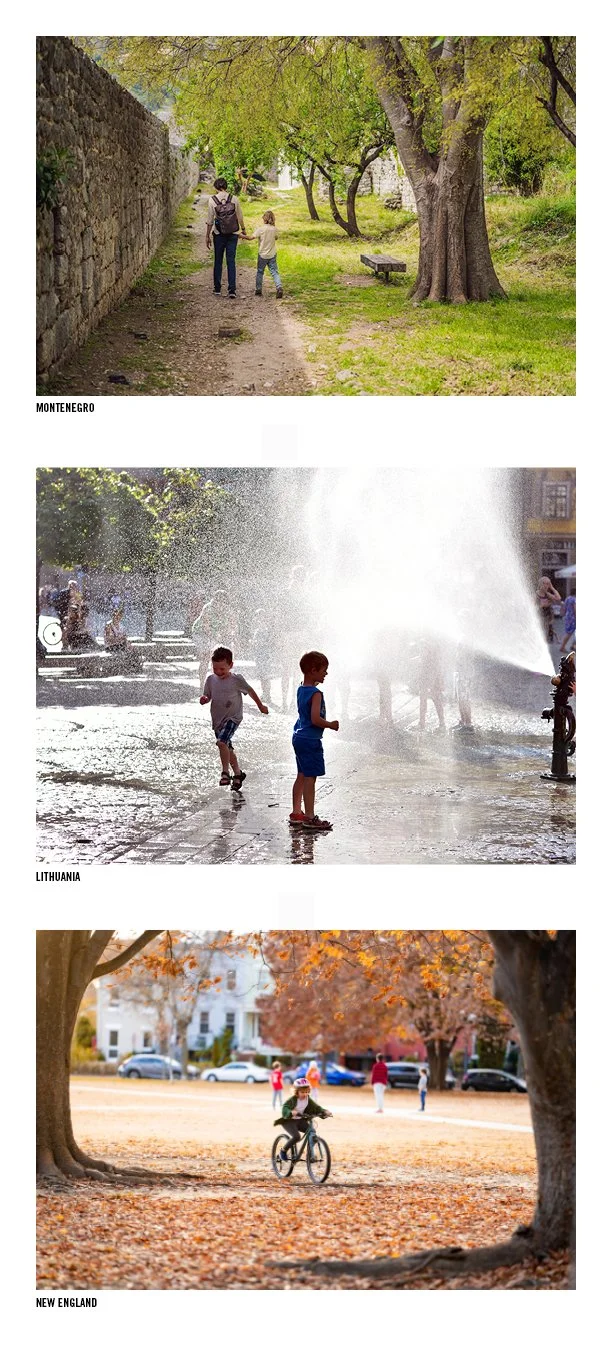
KIDS IN PARKS
ALL Images: Shutterstock.
Our is not a housing problem, it is a design problem, and that what we cannot see this is a failure of imagination (political and otherwise). What young people and young families in our office and in Los Angeles need is not a house and instead—as most young people in most mature cities across the world have—options. That is a bunch of different kinds of homes and places to hang out in a city that is less of a territory and more of a city where outside of our homes we feel at home.
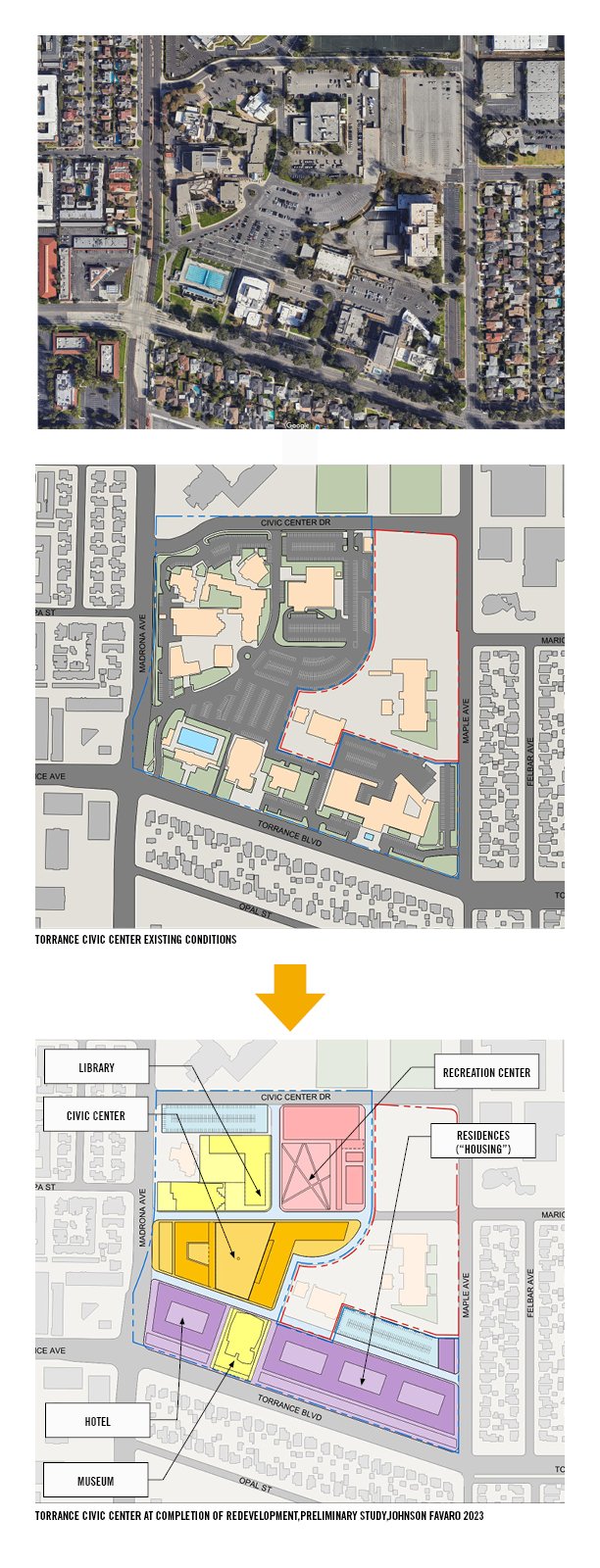
LAND BOUNTY That we claim to have “run out of land” in Los Angeles County is ridiculous at best and criminal at worst (Torrance Civic Center Redevelopment, Preliminary Study, Johnson Favaro, 2023).
TOP IMAGE: Google Maps / Google Earth — Aerial imagery of Torrance Civic Center.
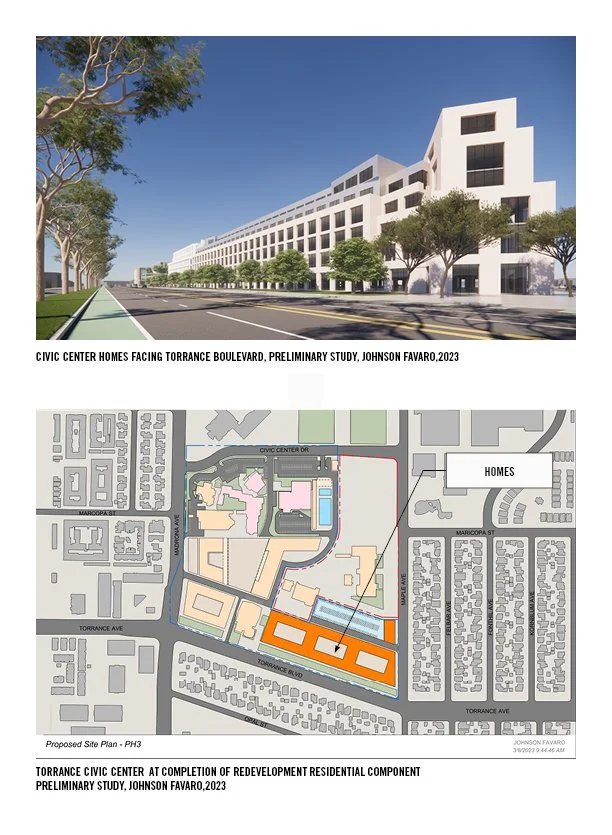
LAND BETTER USED Parks, piazzas, courtyards and streets are what makes a home a home. (Torrance Civic Center Redevelopment, Preliminary Study, Johnson Favaro, 2023).